Pages

Tuesday, September 06, 2005

Kothari products ltd - A Net cash graham situation


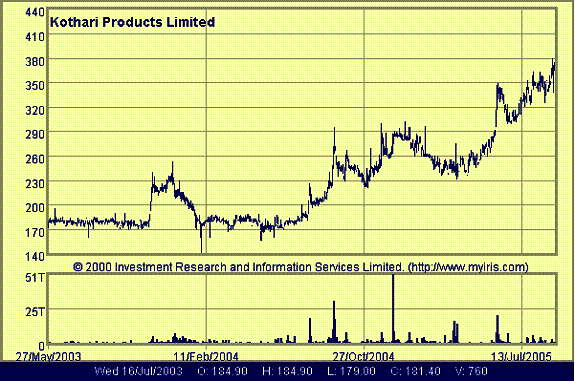
I was running my screen in the year 2003 and came across kothari products. This was a company with 240 crs cash and equivalent (net of debt) on the balance sheet with a market cap of 80 crs ( i think they had 40 mn outstanding shares @ 170 rs / share). They currently have almost 300 crs (around 600 rs per share )

They were fairly profitable (although the profits were down). The market had beaten down the price due to legislation issues (The maharashtra government had banned Pan masala / gutka - their main products). The company was still profitable, although the profits had come down due to drop in sales. Its free cash flow is same as its net profit because Gutka and other tobacco products require little capex for plant and machinery or working capital. The main asset is the brand (in this case pan parag ). So their profits were pure cash for the owners


I bought the share at an price of Rs 160 – 170 a share and sold around 260 per share. The reason I sold was lack of information from the company ( their website is poorly updated in terms of financial results). In addition, I was not sure what the promoters were planning to do with the cash ( the promoters hold almost 70 % of the company).

So what’s the point of the whole thing …Its not that it was a profitable investment. Rather, although I made money on the whole thing, I did not have a very comfortable feeling with the investment. If I compare it with the other purchases I have done such as asian paints, or a concor which are good businesses with good management, this one made me uncomfortable as there was no transparency from the company. In the end I decided to get out rather than face an unpleasant surprise from the management.

My investment philosophy is closer to that of buffet where I end up buying good to great companies at fair prices and get a good night’s sleep. The above was an experiment in a graham style investment. It was profitable and based on a sound approach. But somehow requires more diversification and purchase in not so great enterprises.

Do you have a similar experience? please feel free to share with me

Monday, September 05, 2005

A great talk on value investing from Prof. Bakshi

I visit prof. bakshi's blog regularly. He just posted a talk he gave on valueinvesting at the oxford bookstore in 2002. Great presenation with examples which have done well in the last 3 years. One can learn a lot on valueinvesting (and more in an indian context) from him and his posts.

A great talk on value investing from Prof. Bakshi

I visit prof. bakshi's blog regularly. He just posted a talk he gave on valueinvesting at the oxford bookstore in 2002. Great presenation with examples which have done well in the last 3 years. One can learn a lot on valueinvesting (and more in an indian context) from him and his posts.

Watchout investors !!

A new website from SEBI and ministry of company affairs which lists any non complaince or any voilation of guidelines or rules by people associated with any public listed companies. Great step towards transparency and investor eductation !!


watchoutinvestors.com is a national web-based registry covering entities including companies and intermediaries and, wherever available the persons associated with such entities, who have been indicted for an economic default and/or for non-compliance of laws/guidelines and/or who are no longer in the specified activity. This information which is presently disorganized, difficult-to-use and is spread across a large number of sources i.e. websites, databases, publications, notifications and orders of the government and of other organizations, agencies, courts of law, tribunals and commissions, has been aggregated, indexed, standardised ,reformatted and re-presented in a form and manner that can be accessed in a user friendly manner.

Watchout investors !!

A new website from SEBI and ministry of company affairs which lists any non complaince or any voilation of guidelines or rules by people associated with any public listed companies. Great step towards transparency and investor eductation !!


watchoutinvestors.com is a national web-based registry covering entities including companies and intermediaries and, wherever available the persons associated with such entities, who have been indicted for an economic default and/or for non-compliance of laws/guidelines and/or who are no longer in the specified activity. This information which is presently disorganized, difficult-to-use and is spread across a large number of sources i.e. websites, databases, publications, notifications and orders of the government and of other organizations, agencies, courts of law, tribunals and commissions, has been aggregated, indexed, standardised ,reformatted and re-presented in a form and manner that can be accessed in a user friendly manner.

Blogging for dollar - A new business model for individuals ?

Came across this blog from darren. He seems to have made 100000 usd via blogging in the last 1 year. Seems to be an interesting business model. Can this become a full time source of income ? i dont think so ( and darren suggests the same).

But i think blogs can be become a powerful tool for small time entreprenuers and a creative outlet for a lot of people. In addition a lot of companies can use blogs for internal and external communication (with customers ). Microsoft seems to be doing so.

We may see some companies use blogs in addition to their website to get closer to their customer (experience marketing ?)

It would interesting to see how this medium develop. But it would be safe to say a handful will achieve prominence ( the ones which will pass the tipping point ??) , whereas the rest would remain a labor of love (or pain if you are in it for the money only )

there is an interesting post i read on mark cuban's blog on a similar topic -
podcasting

Blogging for dollar - A new business model for individuals ?

Came across this blog from darren. He seems to have made 100000 usd via blogging in the last 1 year. Seems to be an interesting business model. Can this become a full time source of income ? i dont think so ( and darren suggests the same).

But i think blogs can be become a powerful tool for small time entreprenuers and a creative outlet for a lot of people. In addition a lot of companies can use blogs for internal and external communication (with customers ). Microsoft seems to be doing so.

We may see some companies use blogs in addition to their website to get closer to their customer (experience marketing ?)

It would interesting to see how this medium develop. But it would be safe to say a handful will achieve prominence ( the ones which will pass the tipping point ??) , whereas the rest would remain a labor of love (or pain if you are in it for the money only )

there is an interesting post i read on mark cuban's blog on a similar topic -
podcasting

Saturday, September 03, 2005

Good articles on value investing

Mr Sanjay bakshi is a visiting professor at Management Development Institute, Gurgaon, India. He has a blog - http://www.fundoo_professor.blogspot.com/ and a website http://www.sanjbak.com/ .

He is also the CEO of Tactica Capital Management, an investment boutique. There some very good articles on his website which really worth reading

Good articles on value investing

Mr Sanjay bakshi is a visiting professor at Management Development Institute, Gurgaon, India. He has a blog - http://www.fundoo_professor.blogspot.com/ and a website http://www.sanjbak.com/ .

He is also the CEO of Tactica Capital Management, an investment boutique. There some very good articles on his website which really worth reading

Tuesday, August 23, 2005

Reading a book on Bill miller

I have been reading a book on bill miller from janet lowe

A few things which I learnt

- It is critical to develop a multi-disciplinary model to evaluate companies. This is getting more important as new companies would have more intangible assets than tangible ones and would depend on network effects / customer lock-in etc to create value (like e-bay). even old economy companies will have some component of new economy companies (think about the website of most retailers )
- Importance of understanding business models of these new economy companies and avoiding slotting them into incorrect categories. Bill miller gives an example of amazon.com which is looked at as a retailer and as a result the market has got it wrong several times. According to miller, business model of amazon is closer to dell than walmart (although amazon is using the same wallmart strategy , but online – keep the gross margins constant and pass the benefits to the consumer to build scale )
- The market typically makes an error in evaluating a new business model and is slow to recognize it (but eventually it does). So an investor like miller who has the foresight , can beat the market on these companies (examples given were for dell and amazon )
- Concepts such as network effects, customer lock-in and increasing returns have been discussed briefly in the book with some example.
- Some example of companies which have both new and old economy models
- The book brings out bill miller’s capability to think independently and stand against the crowd ( there is an incident narrated in the book , where it seems in the baron’s panel , one of member asked if bill was drunk when he bought amazon in 2001 – eventually bill was vindicated on his decision

One the most important points which I learnt from the book was to develop an open mind on the new concepts which are coming up and the way they are being used by value investors like bill miller. The growth v/s value tag seems to be immaterial for any company as long as one can assess the intrinsic value of a company and buy it at a discount. Although I may find it difficult to apply these concepts directly, I think these new concepts would help me analyzing and appreciating the new business models which are developing

Reading a book on Bill miller

I have been reading a book on bill miller from janet lowe

A few things which I learnt

- It is critical to develop a multi-disciplinary model to evaluate companies. This is getting more important as new companies would have more intangible assets than tangible ones and would depend on network effects / customer lock-in etc to create value (like e-bay). even old economy companies will have some component of new economy companies (think about the website of most retailers )
- Importance of understanding business models of these new economy companies and avoiding slotting them into incorrect categories. Bill miller gives an example of amazon.com which is looked at as a retailer and as a result the market has got it wrong several times. According to miller, business model of amazon is closer to dell than walmart (although amazon is using the same wallmart strategy , but online – keep the gross margins constant and pass the benefits to the consumer to build scale )
- The market typically makes an error in evaluating a new business model and is slow to recognize it (but eventually it does). So an investor like miller who has the foresight , can beat the market on these companies (examples given were for dell and amazon )
- Concepts such as network effects, customer lock-in and increasing returns have been discussed briefly in the book with some example.
- Some example of companies which have both new and old economy models
- The book brings out bill miller’s capability to think independently and stand against the crowd ( there is an incident narrated in the book , where it seems in the baron’s panel , one of member asked if bill was drunk when he bought amazon in 2001 – eventually bill was vindicated on his decision

One the most important points which I learnt from the book was to develop an open mind on the new concepts which are coming up and the way they are being used by value investors like bill miller. The growth v/s value tag seems to be immaterial for any company as long as one can assess the intrinsic value of a company and buy it at a discount. Although I may find it difficult to apply these concepts directly, I think these new concepts would help me analyzing and appreciating the new business models which are developing

If the market is falling ..why am i smiling ?

for the same reason, when the price of a computer, telecom charges, or any other stuff which i need to buy falls !!

It allows me to buy more of it ....

The above way of thinking is ofcourse not original ...kind of learnt it from warren buffett. But having internalised it, it makes a lot of sense

so every day when the market falls , i smile and hope that the stocks which i am wanting to buy and have not been able to, would be available soon at a good price

If the market is falling ..why am i smiling ?

for the same reason, when the price of a computer, telecom charges, or any other stuff which i need to buy falls !!

It allows me to buy more of it ....

The above way of thinking is ofcourse not original ...kind of learnt it from warren buffett. But having internalised it, it makes a lot of sense

so every day when the market falls , i smile and hope that the stocks which i am wanting to buy and have not been able to, would be available soon at a good price

Wednesday, August 17, 2005

Is it worth investing in the Oil sector


The goverment by controlling the prices is driving the sector to bankruptcy. Trying all kinds of permutations to keep the companies from going bankrupt (see article below). If the oil companies cannot charge market rate (shareholders subsidizing the customer ???!!) , then how is the sector going to make money.
I am still not able to get it (maybe i am missing something ). If the government ( the majority shareholder ) controls the pricing (and profit) of the oil companies at the expense of the minority shareholder with no concern other than the political impact, what is the value of these companies ? how does one value such companies where the future cash flow in addition to being dependent on a volatile oil market is also dependent on a whimsical majority shareholder which has a non economic agenda ! . This sector would start looking like indian railways if the oil prices remain high (which looks likely), that is chronically sick
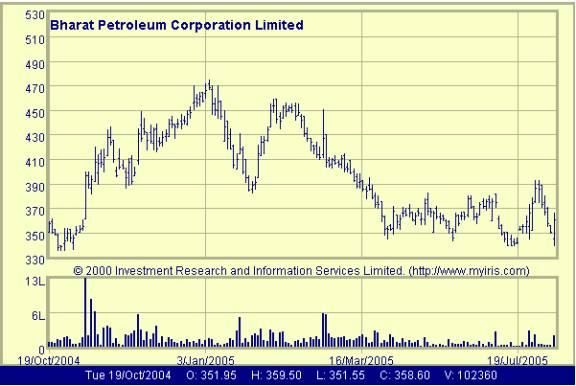
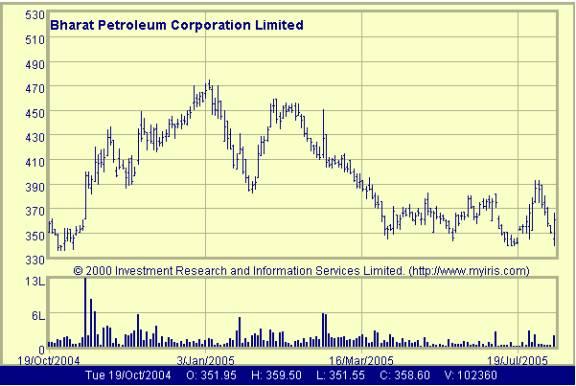
typically oil companies make good profits through forward contracts, hedging etc during rising oil prices (more so if they are vertically integrated). But the indian oil companies are actually down when the overall market is up ( see chart )

To provide cushion for under-recoveries — Standalone refineries may be merged with oil marketing cos --- From hindu business line
Our Bureau
New Delhi , Aug. 17
THE Ministry of Petroleum & Natural Gas is weighing the option of merging pure refining companies with oil marketing companies (OMCs) to enable the latter to cushion the impact of high global crude oil prices on their bottomline.
Due to the freeze by the Government on raising retail prices despite the rise in raw material cost, the fuel retailing business is seen as becoming economically unviable, resulting in OMCs such as Indian Oil Corporation, Bharat Petroleum Corporation, Hindustan Petroleum Corporation and IBP suffering losses.
However, standalone refiners in Chennai, Kochi and Mangalore are making profits as they get the international price for the fuel they produce.
Asked whether the Petroleum Ministry was contemplating such a move, the Petroleum Secretary, Mr S.C. Tripathi, told Business Line that, "various options are being considered. In view of the high crude oil price scenario, some serious structural changes could be made in the downstream sector."
About the suggestion made by the Committee on Synergy in Energy to oil companies asking them to consolidate their businesses, the Secretary said, "we are keeping that also in view."
Explaining the rationale behind such a consideration, a Petroleum Ministry official said standalone refiners were currently earning huge margins, while the OMCs were taking a hit. The merger could help in sharing refining margins with OMCs. "But this is a long-term view and may take some time," he said.
Meanwhile, the bleeding OMCs have been seeking a revision in the prices of the four petroleum products - kerosene, LPG, petrol and diesel.
The companies have incurred a cash loss of Rs 1,516 crore in July. They have sought Rs 5.29 per litre increase in petrol and Rs 4.54 a litre hike in diesel prices. Indications are that the Government is unlikely to consider the price revision before the end of the current session of Parliament.
Also, negotiations were on with the Finance Ministry to consider an excise duty cut, senior officials said.
The Government may consider a hike between Rs 1 and 2 per litre each combined with excise duty reduction on petrol from 8 per cent plus Rs 13 a litre to 8 per cent plus Rs 12 a litre and that on diesel from 8 per cent plus Rs 3.25 a litre to 8 per cent plus Rs 2.25 per litre.

Is it worth investing in the Oil sector


The goverment by controlling the prices is driving the sector to bankruptcy. Trying all kinds of permutations to keep the companies from going bankrupt (see article below). If the oil companies cannot charge market rate (shareholders subsidizing the customer ???!!) , then how is the sector going to make money.
I am still not able to get it (maybe i am missing something ). If the government ( the majority shareholder ) controls the pricing (and profit) of the oil companies at the expense of the minority shareholder with no concern other than the political impact, what is the value of these companies ? how does one value such companies where the future cash flow in addition to being dependent on a volatile oil market is also dependent on a whimsical majority shareholder which has a non economic agenda ! . This sector would start looking like indian railways if the oil prices remain high (which looks likely), that is chronically sick
typically oil companies make good profits through forward contracts, hedging etc during rising oil prices (more so if they are vertically integrated). But the indian oil companies are actually down when the overall market is up ( see chart )

To provide cushion for under-recoveries — Standalone refineries may be merged with oil marketing cos --- From hindu business line
Our Bureau
New Delhi , Aug. 17
THE Ministry of Petroleum & Natural Gas is weighing the option of merging pure refining companies with oil marketing companies (OMCs) to enable the latter to cushion the impact of high global crude oil prices on their bottomline.
Due to the freeze by the Government on raising retail prices despite the rise in raw material cost, the fuel retailing business is seen as becoming economically unviable, resulting in OMCs such as Indian Oil Corporation, Bharat Petroleum Corporation, Hindustan Petroleum Corporation and IBP suffering losses.
However, standalone refiners in Chennai, Kochi and Mangalore are making profits as they get the international price for the fuel they produce.
Asked whether the Petroleum Ministry was contemplating such a move, the Petroleum Secretary, Mr S.C. Tripathi, told Business Line that, "various options are being considered. In view of the high crude oil price scenario, some serious structural changes could be made in the downstream sector."
About the suggestion made by the Committee on Synergy in Energy to oil companies asking them to consolidate their businesses, the Secretary said, "we are keeping that also in view."
Explaining the rationale behind such a consideration, a Petroleum Ministry official said standalone refiners were currently earning huge margins, while the OMCs were taking a hit. The merger could help in sharing refining margins with OMCs. "But this is a long-term view and may take some time," he said.
Meanwhile, the bleeding OMCs have been seeking a revision in the prices of the four petroleum products - kerosene, LPG, petrol and diesel.
The companies have incurred a cash loss of Rs 1,516 crore in July. They have sought Rs 5.29 per litre increase in petrol and Rs 4.54 a litre hike in diesel prices. Indications are that the Government is unlikely to consider the price revision before the end of the current session of Parliament.
Also, negotiations were on with the Finance Ministry to consider an excise duty cut, senior officials said.
The Government may consider a hike between Rs 1 and 2 per litre each combined with excise duty reduction on petrol from 8 per cent plus Rs 13 a litre to 8 per cent plus Rs 12 a litre and that on diesel from 8 per cent plus Rs 3.25 a litre to 8 per cent plus Rs 2.25 per litre.

Tuesday, August 16, 2005

Hotel stocks - some number

Pulled out these number from the equityresearchindia website. Pretty depressing economics ....guess one can make money on one can catch the inflexion point when the economy is turning and the hotel industry is poised to do well ...

2005 2004 2003 2002 2001 2000 1999
A) Return on Equity (i x ii) 9.20% 4.40% 3.20% 4.40% 8.90% 9.50% 11.90%
i) Return on Total Assets
4.70% 2.10% 1.60% 2.40% 5.20% 5.90% 7.90%
ii) Total Assets To Total Equity
2 2.1 2 1.8 1.7 1.6 1.5
B) Return on Total Assets (iii x iv) 4.70% 2.10% 1.60% 2.40% 5.20% 5.90% 7.90%
iii) Net Profit Margin
11.10% 6.60% 5.60% 8.20% 13.90% 15.40% 17.20%
iv) Total Assets Turnover
0.4 0.3 0.3 0.3 0.4 0.4 0.5
C) Total Assets Turnover (v / vi) 0.4 0.3 0.3 0.3 0.4 0.4 0.5
v) Total Income (Rs. Cr.)
3103 2452 2052 1924 2241 2012 2078
vi) Average Total Assets (Rs. Cr.)
7374 7597 7023 6577 5959 5260 4495

Hotel stocks - some number

Pulled out these number from the equityresearchindia website. Pretty depressing economics ....guess one can make money on one can catch the inflexion point when the economy is turning and the hotel industry is poised to do well ...

2005 2004 2003 2002 2001 2000 1999
A) Return on Equity (i x ii) 9.20% 4.40% 3.20% 4.40% 8.90% 9.50% 11.90%
i) Return on Total Assets
4.70% 2.10% 1.60% 2.40% 5.20% 5.90% 7.90%
ii) Total Assets To Total Equity
2 2.1 2 1.8 1.7 1.6 1.5
B) Return on Total Assets (iii x iv) 4.70% 2.10% 1.60% 2.40% 5.20% 5.90% 7.90%
iii) Net Profit Margin
11.10% 6.60% 5.60% 8.20% 13.90% 15.40% 17.20%
iv) Total Assets Turnover
0.4 0.3 0.3 0.3 0.4 0.4 0.5
C) Total Assets Turnover (v / vi) 0.4 0.3 0.3 0.3 0.4 0.4 0.5
v) Total Income (Rs. Cr.)
3103 2452 2052 1924 2241 2012 2078
vi) Average Total Assets (Rs. Cr.)
7374 7597 7023 6577 5959 5260 4495

Hotel stocks

Was looking at the latest results of the hotel industry. The headlines are screaming about the triple digit growths and the tight demand supply situation. The rise in tourist inflows / good business climate are being cited as the reason for the optimism.

I am not too excited by the results or by the economics of the hotel industry. It is typical commodity industry. Some companies have good brand names, but do they have a strong franchise. What i mean by that is, can these companies charge a premium price? . Taj and others can charge a premium compared to the other hotels, but when there is excess supply, the typical occupancy rates and ARR (average room rents) suffer. During such period the margins drop and due to the high fixed costs , even the best of the companies can barely remain in black.

So over a complete business cycle most of the companies in this sector can barely cover their cost of capital. The asset turnover ratios are very low and so to earn a return over their cost of capital, most of these hotels need to maintain a Net profit margin in excess of 10 % ( a tall task when times are bad).

On the contrary this industry looks almost like the steel, cement and the other commodity industry, where only a low cost producer like gujarat ambuja or Tata steel can be profitable over the long term. Can't think of any such hotel company ...

Compare this with the FMCG/Pharma/IT and most of these companies even during a downturn, earn over their cost of capital.

As a side note, ITC seems to be investing their cash flows from ciggarette business to hotels, Paper and FMCG which are businesses with poor economics. Granted , that the company is getting growth, but is it profitable ( doesnt seem to be as of now)?

Hotel stocks

Was looking at the latest results of the hotel industry. The headlines are screaming about the triple digit growths and the tight demand supply situation. The rise in tourist inflows / good business climate are being cited as the reason for the optimism.

I am not too excited by the results or by the economics of the hotel industry. It is typical commodity industry. Some companies have good brand names, but do they have a strong franchise. What i mean by that is, can these companies charge a premium price? . Taj and others can charge a premium compared to the other hotels, but when there is excess supply, the typical occupancy rates and ARR (average room rents) suffer. During such period the margins drop and due to the high fixed costs , even the best of the companies can barely remain in black.

So over a complete business cycle most of the companies in this sector can barely cover their cost of capital. The asset turnover ratios are very low and so to earn a return over their cost of capital, most of these hotels need to maintain a Net profit margin in excess of 10 % ( a tall task when times are bad).

On the contrary this industry looks almost like the steel, cement and the other commodity industry, where only a low cost producer like gujarat ambuja or Tata steel can be profitable over the long term. Can't think of any such hotel company ...

Compare this with the FMCG/Pharma/IT and most of these companies even during a downturn, earn over their cost of capital.

As a side note, ITC seems to be investing their cash flows from ciggarette business to hotels, Paper and FMCG which are businesses with poor economics. Granted , that the company is getting growth, but is it profitable ( doesnt seem to be as of now)?

Monday, August 15, 2005

Added two blogs

I have added two blogs which i frequently read . One is mark cuban's blog and the other Victor Niederhoffer

Mark's biography is below
http://www.nba.com/mavericks/news/cuban_bio000329.html

and victor's is below

http://www.dailyspeculations.com/aboutus.htm

Both write excellent and thought provoking blogs

Added two blogs

I have added two blogs which i frequently read . One is mark cuban's blog and the other Victor Niederhoffer

Mark's biography is below
http://www.nba.com/mavericks/news/cuban_bio000329.html

and victor's is below

http://www.dailyspeculations.com/aboutus.htm

Both write excellent and thought provoking blogs

Competition

Found this posting Victor Niederhoffer's blog on competition. I agree competition is good for society / consumer , but bad for an investor. I would prefer a company which is close to a unregulated monopoly ( a toll bridge as buffett says )

Competition, by Victor Niederhoffer:
Competition in its many aspects -- markets, trees, companies, old heartedness, protection of consumers, romance -- is the main force responsible for our high standard of living. It brings out the best in us and provides the consumer with the price and quality he wants. James Lorie, along with Franklin Fisher, was one of the chief consultants for IBM in the antitrust action against it in the 1970s. I came across this quote by Fisher vis a vis the similarities to the Microsoft case:
Every practice that the government complained of had to due basically with the offering of better products or lower prices. The government did not understand that that is the way competition works.
He then goes on to show how IBM had developed a better and smaller disk and the government complained it was a predatory device.
If only the public were educated to realize that there is always someone waiting around to provide a product at a more attractive price or quality or time or convenience, then so much wasted envy and loss would be averted.

Competition

Found this posting Victor Niederhoffer's blog on competition. I agree competition is good for society / consumer , but bad for an investor. I would prefer a company which is close to a unregulated monopoly ( a toll bridge as buffett says )

Competition, by Victor Niederhoffer:
Competition in its many aspects -- markets, trees, companies, old heartedness, protection of consumers, romance -- is the main force responsible for our high standard of living. It brings out the best in us and provides the consumer with the price and quality he wants. James Lorie, along with Franklin Fisher, was one of the chief consultants for IBM in the antitrust action against it in the 1970s. I came across this quote by Fisher vis a vis the similarities to the Microsoft case:
Every practice that the government complained of had to due basically with the offering of better products or lower prices. The government did not understand that that is the way competition works.
He then goes on to show how IBM had developed a better and smaller disk and the government complained it was a predatory device.
If only the public were educated to realize that there is always someone waiting around to provide a product at a more attractive price or quality or time or convenience, then so much wasted envy and loss would be averted.

A new world economy

A new article on india and china. interesting to read

http://www.businessweek.com/magazine/content/05_34/b3948401.htm

some excerpts

Even more exhilarating is the pace of innovation, as tech hubs like Bangalore spawn companies producing their own chip designs, software, and pharmaceuticals. "I find Bangalore to be one of the most exciting places in the world," says Dan Scheinman, Cisco Systems Inc.'s senior vice-president for corporate development. "It is Silicon Valley in 1999." Beyond Bangalore, Indian companies are showing a flair for producing high-quality goods and services at ridiculously low prices, from $50 air flights and crystal-clear 2 cents-a-minute cell-phone service to $2,200 cars and cardiac operations by top surgeons at a fraction of U.S. costs. Some analysts see the beginnings of hypercompetitive multinationals. "Once they learn to sell at Indian prices with world quality, they can compete anywhere," predicts University of Michigan management guru C.K. Prahalad. Adds A. T. Kearney high-tech consultant John Ciacchella: "I don't think U.S. companies realize India is building next-generation service companies."

Barring cataclysm, within three decades India should have vaulted over Germany as the world's third-biggest economy. By mid-century, China should have overtaken the U.S. as No. 1. By then, China and India could account for half of global output. Indeed, the troika of China, India, and the U.S. -- the only industrialized nation with significant population growth -- by most projections will dwarf every other economy.

China also is hugely wasteful. Its 9.5% growth rate in 2004 is less impressive when you consider that $850 billion -- half of GDP -- was plowed into already-glutted sectors like crude steel, vehicles, and office buildings. Its factories burn fuel five times less efficiently than in the West, and more than 20% of bank loans are bad. Two-thirds of China's 13,000 listed companies don't earn back their true cost of capital, estimates Beijing National Accounting Institute President Chen Xiaoyue. "We build the roads and industrial parks, but we sacrifice a lot," Chen says.India, by contrast, has had to develop with scarcity. It gets scant foreign investment, and has no room to waste fuel and materials like China. India also has Western legal institutions, a modern stock market, and private banks and corporations. As a result, it is far more capital-efficient. A BusinessWeek analysis of Standard & Poor's (
MHP ) Compustat data on 346 top listed companies in both nations shows Indian corporations have achieved higher returns on equity and invested capital in the past five years in industries from autos to food products. The average Indian company posted a 16.7% return on capital in 2004, vs. 12.8% in China.

The burning question is whether India can replicate China's mass manufacturing achievement. India's info-tech services industry, successful as it is, employs fewer than 1 million people. But 200 million Indians subsist on $1 a day or less. Export manufacturing is one of India's best hopes of generating millions of new jobs.India has sophisticated manufacturing knowhow. Tata Steel is among the world's most-efficient producers. The country boasts several top precision auto parts companies, such as Bharat Forge Ltd. The world's biggest supplier of chassis parts to major auto makers, it employs 1,200 engineers at its heavily automated Pune plant. India's forte is small-batch production of high-value goods requiring lots of engineering, such as power generators for Cummins Inc. (
CMI ) and core components for General Electric Co. (GE ) CAT scanners.

A new world economy

A new article on india and china. interesting to read

http://www.businessweek.com/magazine/content/05_34/b3948401.htm

some excerpts

Even more exhilarating is the pace of innovation, as tech hubs like Bangalore spawn companies producing their own chip designs, software, and pharmaceuticals. "I find Bangalore to be one of the most exciting places in the world," says Dan Scheinman, Cisco Systems Inc.'s senior vice-president for corporate development. "It is Silicon Valley in 1999." Beyond Bangalore, Indian companies are showing a flair for producing high-quality goods and services at ridiculously low prices, from $50 air flights and crystal-clear 2 cents-a-minute cell-phone service to $2,200 cars and cardiac operations by top surgeons at a fraction of U.S. costs. Some analysts see the beginnings of hypercompetitive multinationals. "Once they learn to sell at Indian prices with world quality, they can compete anywhere," predicts University of Michigan management guru C.K. Prahalad. Adds A. T. Kearney high-tech consultant John Ciacchella: "I don't think U.S. companies realize India is building next-generation service companies."

Barring cataclysm, within three decades India should have vaulted over Germany as the world's third-biggest economy. By mid-century, China should have overtaken the U.S. as No. 1. By then, China and India could account for half of global output. Indeed, the troika of China, India, and the U.S. -- the only industrialized nation with significant population growth -- by most projections will dwarf every other economy.

China also is hugely wasteful. Its 9.5% growth rate in 2004 is less impressive when you consider that $850 billion -- half of GDP -- was plowed into already-glutted sectors like crude steel, vehicles, and office buildings. Its factories burn fuel five times less efficiently than in the West, and more than 20% of bank loans are bad. Two-thirds of China's 13,000 listed companies don't earn back their true cost of capital, estimates Beijing National Accounting Institute President Chen Xiaoyue. "We build the roads and industrial parks, but we sacrifice a lot," Chen says.India, by contrast, has had to develop with scarcity. It gets scant foreign investment, and has no room to waste fuel and materials like China. India also has Western legal institutions, a modern stock market, and private banks and corporations. As a result, it is far more capital-efficient. A BusinessWeek analysis of Standard & Poor's (
MHP ) Compustat data on 346 top listed companies in both nations shows Indian corporations have achieved higher returns on equity and invested capital in the past five years in industries from autos to food products. The average Indian company posted a 16.7% return on capital in 2004, vs. 12.8% in China.

The burning question is whether India can replicate China's mass manufacturing achievement. India's info-tech services industry, successful as it is, employs fewer than 1 million people. But 200 million Indians subsist on $1 a day or less. Export manufacturing is one of India's best hopes of generating millions of new jobs.India has sophisticated manufacturing knowhow. Tata Steel is among the world's most-efficient producers. The country boasts several top precision auto parts companies, such as Bharat Forge Ltd. The world's biggest supplier of chassis parts to major auto makers, it employs 1,200 engineers at its heavily automated Pune plant. India's forte is small-batch production of high-value goods requiring lots of engineering, such as power generators for Cummins Inc. (
CMI ) and core components for General Electric Co. (GE ) CAT scanners.

Measuring the moat - framework for evaluating competitive advantage

found this article on Michael Mauboussin's website. Absolutely fantastic article. Extremely helpful in developing a framework for evaluating a companies competitive advantage.
http://www.capatcolumbia.com/Articles/measuringthemoat.pdf

In addition , micheal has published this new article on the legg mason website. A must read !!

http://www.leggmason.com/funds/knowledge/mauboussin/Aver_and_Aversion.pdf

Measuring the moat - framework for evaluating competitive advantage

found this article on Michael Mauboussin's website. Absolutely fantastic article. Extremely helpful in developing a framework for evaluating a companies competitive advantage.
http://www.capatcolumbia.com/Articles/measuringthemoat.pdf

In addition , micheal has published this new article on the legg mason website. A must read !!

http://www.leggmason.com/funds/knowledge/mauboussin/Aver_and_Aversion.pdf

Friday, August 12, 2005

Analysing the auto component industry

I have been studying the Indian auto component industry for the last few days. The industry appears to have a good future ahead (whether there are some good stocks at good valuation is something i need to check).
The auto industry has two main channel - OEM and After sales. The industry has been restricted mainly to the domestic industry in the past and was thus tied to the fortune of the domestic auto industry (which in turn is cyclical).


A few changes have happened which have opened up the export market to this industry
- Recognition of India for its technical manpower. This is crucial especially in auto which involves a lot of R&D and design for new components at the higher end of the value chain
- Low cost labor
- Opening up of the Auto sector by the Indian government, due to which the global majors such as ford, GM etc setup shop in India and started sourcing from local suppliers. This helped in improving the competitiveness of the Indian auto component makers
- increase in scale of the domestic auto component makers and foray into the export market
Industry landscape

Some of the key firms in the industry in terms of their size are
- Bharat forge
- MICO
- Motherson Sumi
- Exide
- Sundaram fastners

Porter’s 5 factor analysis
Barriers to entry
- Technology: several auto components have a high technology component and can be produced by only those companies which have access to the technology or have developed it themselves. As a result most of the auto makers specialize in specific components
- Economies of scale
- Brand is crucial, more so in the Spares market (and as a result a distribution network too)
- Customer relationship in the form of long term contracts
Rivalry among firms
Rivalry among firms would be high in Spares market, but lesser in the export markets wherein the norm is long term contract. In addition the industry has high technology component and hence the industry does not deal in completely commodity product. However competition could be from other firms from other countries in a similar product line
Supplier power should be low as the key raw material is steel which in itself is a commodity

Buyer power is high especially for the OEM market and with high competition between auto makers there should be a constant pricing pressure on the auto component makers going forward

I would consider the threat of substitute product as low

The key success factors for the industry going forward should
- Continued investment into technology/ process to build barriers to competition and provide a cost and quality advantage to the customer
- Pursuit of economies of scale to be cost competitive. It should be in both production and in R&D
- Developing strong customer relationship through quality and reliable supply

Key risks
- Pricing would remain under pressure going forward
- Inability to meet the supply schedules of the customer
- Development of alternative outsourcing locations

The industry is into a growth phase. However the market also seems to have recognized that and most of the companies seem to be fairly valued.

Analysing the auto component industry

I have been studying the Indian auto component industry for the last few days. The industry appears to have a good future ahead (whether there are some good stocks at good valuation is something i need to check).
The auto industry has two main channel - OEM and After sales. The industry has been restricted mainly to the domestic industry in the past and was thus tied to the fortune of the domestic auto industry (which in turn is cyclical).


A few changes have happened which have opened up the export market to this industry
- Recognition of India for its technical manpower. This is crucial especially in auto which involves a lot of R&D and design for new components at the higher end of the value chain
- Low cost labor
- Opening up of the Auto sector by the Indian government, due to which the global majors such as ford, GM etc setup shop in India and started sourcing from local suppliers. This helped in improving the competitiveness of the Indian auto component makers
- increase in scale of the domestic auto component makers and foray into the export market
Industry landscape

Some of the key firms in the industry in terms of their size are
- Bharat forge
- MICO
- Motherson Sumi
- Exide
- Sundaram fastners

Porter’s 5 factor analysis
Barriers to entry
- Technology: several auto components have a high technology component and can be produced by only those companies which have access to the technology or have developed it themselves. As a result most of the auto makers specialize in specific components
- Economies of scale
- Brand is crucial, more so in the Spares market (and as a result a distribution network too)
- Customer relationship in the form of long term contracts
Rivalry among firms
Rivalry among firms would be high in Spares market, but lesser in the export markets wherein the norm is long term contract. In addition the industry has high technology component and hence the industry does not deal in completely commodity product. However competition could be from other firms from other countries in a similar product line
Supplier power should be low as the key raw material is steel which in itself is a commodity

Buyer power is high especially for the OEM market and with high competition between auto makers there should be a constant pricing pressure on the auto component makers going forward

I would consider the threat of substitute product as low

The key success factors for the industry going forward should
- Continued investment into technology/ process to build barriers to competition and provide a cost and quality advantage to the customer
- Pursuit of economies of scale to be cost competitive. It should be in both production and in R&D
- Developing strong customer relationship through quality and reliable supply

Key risks
- Pricing would remain under pressure going forward
- Inability to meet the supply schedules of the customer
- Development of alternative outsourcing locations

The industry is into a growth phase. However the market also seems to have recognized that and most of the companies seem to be fairly valued.

Thursday, August 04, 2005

Black Swan effect – Fat outliers / Why EMT varies from reality

EMT – Efficient market hypothesis has been debated to death. There are people who swear by it, atleast in the weak form.

One area where EMT differs from reality is in its modeling of outliers, rare events or black swan (This is the term used by Nicholas M Taleb).

To get a better understand of this topic, I have been reading the book – Fooled by randomness – by Nicholas M Taleb. He uses a lot of real life examples to explain some very complex concepts.

Some ideas which have remained with me are

- Black swan or Rare events or Outlier events happen more frequently than one would think so (drawback of the EMT ? )

- The EMT models the market by normal distribution, which does not take account of these outlier events. Hence you find these spectacular hedge fund blow up like LTCM where a rare event takes the fund down

- People under estimate chance in life and attribute it to skill (in investing too)

- Human mind is not designed to be rational, especially in the area of finance and we tend to make emotional suboptimal decision

- The pain of loss is 2-2.5 times more than the pleasure of gain. As a result, if one has the tendency to check his portfolio too often, it could have a negative impact on the performance ( if one were to act irrationally based on the short term performance )

- Most of the studies on long term performance of stocks / mutual funds have a survivorship bias due to which the performance appears better than it actually is (for ex: the current sensex does not have all those companies which were a part of it and went bankrupt or got knocked off)

A good book and a must read !!

Black Swan effect – Fat outliers / Why EMT varies from reality

EMT – Efficient market hypothesis has been debated to death. There are people who swear by it, atleast in the weak form.

One area where EMT differs from reality is in its modeling of outliers, rare events or black swan (This is the term used by Nicholas M Taleb).

To get a better understand of this topic, I have been reading the book – Fooled by randomness – by Nicholas M Taleb. He uses a lot of real life examples to explain some very complex concepts.

Some ideas which have remained with me are

- Black swan or Rare events or Outlier events happen more frequently than one would think so (drawback of the EMT ? )

- The EMT models the market by normal distribution, which does not take account of these outlier events. Hence you find these spectacular hedge fund blow up like LTCM where a rare event takes the fund down

- People under estimate chance in life and attribute it to skill (in investing too)

- Human mind is not designed to be rational, especially in the area of finance and we tend to make emotional suboptimal decision

- The pain of loss is 2-2.5 times more than the pleasure of gain. As a result, if one has the tendency to check his portfolio too often, it could have a negative impact on the performance ( if one were to act irrationally based on the short term performance )

- Most of the studies on long term performance of stocks / mutual funds have a survivorship bias due to which the performance appears better than it actually is (for ex: the current sensex does not have all those companies which were a part of it and went bankrupt or got knocked off)

A good book and a must read !!

Buffett's 1974 Forbes interview

A classic !!

http://www.maoxian.com/archive/20030108.html

Buffett's 1974 Forbes interview

A classic !!

http://www.maoxian.com/archive/20030108.html

Wednesday, August 03, 2005

No one Looks good !! - lesson for investors

A fantastic post on the Fool's BRK board from elias fardo. Its a must read for a value investor

http://www.fool.com/community/pod/2005/050802.htm?ref=foolwatch

If one were to follow these principles, he could the harshad mehta bust, the MS shoes debacles, the fraudulent IPO's of the past and a host of other scams.

No one Looks good !! - lesson for investors

A fantastic post on the Fool's BRK board from elias fardo. Its a must read for a value investor

http://www.fool.com/community/pod/2005/050802.htm?ref=foolwatch

If one were to follow these principles, he could the harshad mehta bust, the MS shoes debacles, the fraudulent IPO's of the past and a host of other scams.

Tuesday, August 02, 2005

Distinguishing between a commodity business and franchise

One of the analysis i have been doing for some time is to analyse various industries like cement, steel, media, gas , FMCG etc and try to asess their competitive scenario. The reason for doing this analysis is to gain a better understanding of these industries, compare them with each other and also to develop some kind of models / categorisations.

One of the frustations i have felt , is the lack of litreature on the various types of business models. The typical one that get discussed are the ideal franchise like business models like coke ( at global level ) or nestle, asian paints, HLL etc at an indian level. The other extreme are the absolute commodity type businesses like airlines, steel ( i agree that within these commodity type business there are some value creating companies).

But there are businesses out there, which lie between the two extremes. For example auto components, power , banks, branded textiles etc. I am trying to analyse these various industries on porter's five factor model and other variables so that i can conceptually think about a business and assign it to a model (not the best approach, but makes it easier to analyse a company and gives a starting point

While i was doing this, yesterday, i came across one such exercise being done ( http://pink-sheets.blogspot.com/ <http://pink-sheets.blogspot.com/> ). Should be helpful to me in my exercise

Distinguishing between a commodity business and franchise

One of the analysis i have been doing for some time is to analyse various industries like cement, steel, media, gas , FMCG etc and try to asess their competitive scenario. The reason for doing this analysis is to gain a better understanding of these industries, compare them with each other and also to develop some kind of models / categorisations.

One of the frustations i have felt , is the lack of litreature on the various types of business models. The typical one that get discussed are the ideal franchise like business models like coke ( at global level ) or nestle, asian paints, HLL etc at an indian level. The other extreme are the absolute commodity type businesses like airlines, steel ( i agree that within these commodity type business there are some value creating companies).

But there are businesses out there, which lie between the two extremes. For example auto components, power , banks, branded textiles etc. I am trying to analyse these various industries on porter's five factor model and other variables so that i can conceptually think about a business and assign it to a model (not the best approach, but makes it easier to analyse a company and gives a starting point

While i was doing this, yesterday, i came across one such exercise being done ( http://pink-sheets.blogspot.com/ <http://pink-sheets.blogspot.com/> ). Should be helpful to me in my exercise

Friday, July 29, 2005

Buffett's comment on telecom industry

The other day i posted a link for a talk which buffett gave in omaha. One of the question was on his opinion of the telecom industry. He said that he cannot predict the future of industry ( said he does not even know the complete history) and the industry has too much change (which is bad for the investor)

This had me thinking and then i came across this article below in economist (link given , i have added on a portion of the article as it could have some copyright issues ). On reading this article, i think one would tend to agree with buffett. It is very difficult to really predict the long term business model of the telecom industry. Today VOIP is the killer app , tomorrow it could be something else ....

http://www.economist.com/business/displayStory.cfm?story_id=4232442

Established telecoms companies are fighting an increasingly bitter battle against innovative attackers

That is because IPTV forms part of a larger, and quite desperate, defensive strategy now being adopted by telecoms firms against fierce attacks on multiple fronts. On one front are cable giants, such as America's Comcast, which are luring customers with an enticing “triple-play bundle” of TV, broadband and telephony services. On a second front are mobile-phone operators, which young customers in particular are increasingly using to “cut the cord” from their fixed-line company.

But arguably most dangerous of all is the third front, where traditional telecoms firms are under attack from voice-over-internet-protocol (VOIP) providers, which use the internet to carry conversations that would previously have taken place via a conventional phone. TeleGeography, a research firm, estimates that the number of subscribers to VOIP services such as Vonage, which lets users plug their traditional phones into a gadget connected to the internet, will grow from 1.8m at the start of this year to 4m by the end of December in America alone; by 2010, it projects over 17m American subscribers. This does not count the world's largest VOIP provider, Skype, which uses a small and simple software application to let users make free calls between computers—so far, it has been downloaded 141m times.

Hanging on the telephone

Traditional telecoms firms are doing their best to respond to these threats by adopting internet technologies themselves. This week, VSNL, the top operator in India for international calls, said it would buy Teleglobe, the world's largest international wholesale VOIP carrier. Every big telecoms firm is investing to migrate from old, circuit-switched networks to new internet-based ones, with Britain's BT probably moving fastest. The threat from VOIP would then be neutralised, as the telecoms firms themselves would be providing it. Even so, VOIP makes already grim revenue forecasts for old-style telecoms firms look truly depressing (see chart).

Buffett's comment on telecom industry

The other day i posted a link for a talk which buffett gave in omaha. One of the question was on his opinion of the telecom industry. He said that he cannot predict the future of industry ( said he does not even know the complete history) and the industry has too much change (which is bad for the investor)

This had me thinking and then i came across this article below in economist (link given , i have added on a portion of the article as it could have some copyright issues ). On reading this article, i think one would tend to agree with buffett. It is very difficult to really predict the long term business model of the telecom industry. Today VOIP is the killer app , tomorrow it could be something else ....

http://www.economist.com/business/displayStory.cfm?story_id=4232442

Established telecoms companies are fighting an increasingly bitter battle against innovative attackers

That is because IPTV forms part of a larger, and quite desperate, defensive strategy now being adopted by telecoms firms against fierce attacks on multiple fronts. On one front are cable giants, such as America's Comcast, which are luring customers with an enticing “triple-play bundle” of TV, broadband and telephony services. On a second front are mobile-phone operators, which young customers in particular are increasingly using to “cut the cord” from their fixed-line company.

But arguably most dangerous of all is the third front, where traditional telecoms firms are under attack from voice-over-internet-protocol (VOIP) providers, which use the internet to carry conversations that would previously have taken place via a conventional phone. TeleGeography, a research firm, estimates that the number of subscribers to VOIP services such as Vonage, which lets users plug their traditional phones into a gadget connected to the internet, will grow from 1.8m at the start of this year to 4m by the end of December in America alone; by 2010, it projects over 17m American subscribers. This does not count the world's largest VOIP provider, Skype, which uses a small and simple software application to let users make free calls between computers—so far, it has been downloaded 141m times.

Hanging on the telephone

Traditional telecoms firms are doing their best to respond to these threats by adopting internet technologies themselves. This week, VSNL, the top operator in India for international calls, said it would buy Teleglobe, the world's largest international wholesale VOIP carrier. Every big telecoms firm is investing to migrate from old, circuit-switched networks to new internet-based ones, with Britain's BT probably moving fastest. The threat from VOIP would then be neutralised, as the telecoms firms themselves would be providing it. Even so, VOIP makes already grim revenue forecasts for old-style telecoms firms look truly depressing (see chart).

Tuesday, July 26, 2005

Checking on pidilite results

Just saw pidilite industries results yesterday. The topline growth in consumer goods is still very strong ( 15% +). The industrial division continues to do well too. The bottomline was under pressure which i expected with the oil prices being high and one of the key raw materials being VAM which is dependent on crude prices.

Pidilite continue to do well, increasing market shares in the key categories ( i need to figure, how the new products are doing ).

The only worry which i have had with pidilite, which has prevented me from expanding on my holding, is what would the management do with all the free cash flows. The past record has been patchy. They have invested in windmills !! loaned to subsidiary companies and so on. somehow i have not been to been able to be comfortable on this factor.

But fundamentally the business continues to perform well

Checking on pidilite results

Just saw pidilite industries results yesterday. The topline growth in consumer goods is still very strong ( 15% +). The industrial division continues to do well too. The bottomline was under pressure which i expected with the oil prices being high and one of the key raw materials being VAM which is dependent on crude prices.

Pidilite continue to do well, increasing market shares in the key categories ( i need to figure, how the new products are doing ).

The only worry which i have had with pidilite, which has prevented me from expanding on my holding, is what would the management do with all the free cash flows. The past record has been patchy. They have invested in windmills !! loaned to subsidiary companies and so on. somehow i have not been to been able to be comfortable on this factor.

But fundamentally the business continues to perform well

cannot upload files

i have been trying to figure a way to upload files on warren buffett's visit to various colleges, articles on ben graham etc. unfortunately have not been able to find any way to do so ...if any one has an idea can you please leave a comment

thanks !

cannot upload files

i have been trying to figure a way to upload files on warren buffett's visit to various colleges, articles on ben graham etc. unfortunately have not been able to find any way to do so ...if any one has an idea can you please leave a comment

thanks !

Monday, July 25, 2005

Excerpts from warren buffett's 1997 Caltech Speech

Found these excerpts on the fool.com website.

This speech is useful in resovling some question we all have as investors
- how do i accumulate a decent nest egg
- what to focus on when analysing a business (important and knowable)
- how to investigate / research a company


The first section of the speech I have quoted was Mr. Buffett's answer to the moderator's question on how individuals can grow their investment portfolio. I think this is the first time I have heard of him using the snowball analogy.

Mr. Buffett: “The first thing to realize is that it takes a long time. I started when I was eleven. Accumulating money is a little like having a snowball going downhill, it's important to have a very long hill. I've had a fifty-six year hill. It's important to work in sticky snow and you need a little snowball to start with, which I got from delivery the post actually. It's better if you're not in too much of a hurry and keep doing sound things.”

“The biggest thing I've had going for me is that we have never had big loses. I think almost everyone on Wall Street has had winners that were comparable to what we've had at Berkshire Hathaway but we have tended to avoid the losers and we have done that by trying to stick in what I call my circle of competence. I think that is the biggest thing in business, figuring out where you are good and where you are not. It doesn't make any difference how big the circle is the important thing is that you know where the perimeter is. You can have a very small circle but if you stay within that circle you'll do fine. It's like Tom Watson said, “I'm no genius but I'm smart in spots and I stay around those spots.

”“Well that is what I try to do in investments. I try to stick with companies that I can understand. You don't always have huge winners that way but you'll almost never lose any significant money. So come back and see me in 56 years and tell me how it worked.

”The second section of the speech is important because it provides us with an understanding of exactly what ideas of Mr. Graham actually caught the interest of Mr. Buffett. I also find it interesting that another great investment mind besides Mr. Graham found that technical analysis is useless. Another idea that he brings up in this section is how knowledge builds on itself. I think that is especially true for investors that already think of the investment process correctly but could present problems to those that follow technical analysis or believe in the EMT.

Mr. Buffett: “Well, the biggest thing was picking up a book when I was nineteen by Benjamin Graham called the Intelligent Investor. I had been interested in stocks since I was six or seven and I'd charted and done all this technical analysis, it was a lot of fun but it wasn't very profitable. I read the Intelligent Investor and it really had three important ideas in it: Think of a stock as part of a business, don't think of it as some little ticker symbol moving around but think of it as actually buying a piece of a business just like you'd buy a service station or a dry cleaning establishment in your hometown. Instead you're buying one-onehundredth of a percent of General Motors.”“Think of what you understand about the business and how you can value it. If it's one you can't understand then go onto the next one. His second concept of your attitude toward stock market changes is prices so that he said the stock market was there to serve you not to instruct you. So essentially he said that when a stock goes down that is good news if you know what you're doing because it just means that you can buy more of a business that you like even cheaper.

“Finally the concept of a Margin of Safety which he said if you were driving a car or a truck that weighs 9800 pounds and you see a bridge that says limit 10,000 pounds you go look for another bridge that says 20,000 pounds and you only buy securities when you think they are substantially below what you think they are worth. Those concepts all made sense to me.” “Those fundamental principles applied in various ways are the key to it [investing]. I've had an additional advantage in that I have been in both business and in investments so I have actually seen businesses.

”“Owning See's Candies, which we bought in 1972, really taught me a lot about the value of brands and what could be done with them so I understood Coca-Cola better when it came along in 1988 then if I had never been in Sees. We've got a profit of close to $10 billion dollars in Coke now a significant part of that is attributable to the fact that we bought Sees Candy for $25 million dollars in 1972.

”“The nice thing about investments is that knowledge accumulates on you and if you understand a business or industry once you are going to understand it for the next fifty years. There may be whole big areas you don't understand, like technology would be with me) but once you understand candy you understand candy.

”The following quote, in my opinion, is a little plug in favor of focus investing.

Mr. Buffett: “When I miss on a business that I can understand, that I know about, and I don't so something big, doing something small is a great sin in my view. [Those situations] have cost us billions of dollars literally”.

This next answer provides investors with a compelling way to think about investing. His advocating on focusing on the real issues and ignoring the items that don't matter in the overall equation is a great repudiation of the investing theories behind momentum market players.

Mr. Buffett: “Well, if I could do it would eliminate a lot of other problems. I wouldn't have to sit and think about whether Coca-Cola had a decent business or Gillette or something of the sort. It's just that I don't know how to do it and in business you're looking for things that are important and knowable. If they're not important than forget them and if they're not knowable forget them but if they are important they are knowable and then the question is can you find things that are important and knowable? And you can but predicting the market is one that may be important but in my view is not knowable and I don't know anyone who has made large amounts of money by predicting the market. If you can't do it then you don't want to let it interfere with something you can do.

”“Coca-Cola went public in 1919 or 1920 at $40 a share. It went to $19 within the year. It lost over 50% of its value, sugar went up in price and there were some other things. Now if you thought the market was there to instruct you might think this was a terrible business and I'd better get out of it. Or if you thought you saw the Great Depression coming or World War II, or all of these things you could sit there and think about all kinds of things. The important thing was to recognize what Coca-Cola was so if you put $40 dollars or $19 dollars at the start of that year it would be worth about $5 million now. That is what you really want, the big idea that you can understand.

”In the following answer Mr. Buffett explains how investors can use their own circle of competence in the investment process. I think you'll enjoy the investigative reporter analogy.

Mr. Buffett: “Well, it is interesting that you mention reporting because Bob Woodward I think back in 73 or 74 when I first got interested in the post we had lunch at the Madison and he was saying what he might so with his money and I said Bob why don't you assign yourself a story, get up an hour early every morning and work on a story you've assigned yourself. Now a sensible story to assign yourself would be what is the Washington Post Company worth. Now if Bradley gave you that story to work on what would you do for the next week or two? You go around and talk to people at Rand Television stations, Brokered Television Stations [?] bought them, and you would try to figure out what are the key variables in valuing a television station and you would look at the four that the Post has and apply those standards to that.”


“You would do the same thing to newspapers. You would try to figure out how the competitive battle between the Star and the Post was going to come out and how much difference the world would might be if the Post won that war then it was at the present time and what Newsweek. All of these things are a lot easier than the problems Woodward would usually be working on. Usually people wouldn't want to talk to him but on this subject they would be glad to talk to him and then I said when you get all through with that add it up, divide by the number of shares outstanding. All he had to do was assign himself the right story and I assign myself stories from time to time.”

“I may assign myself the story about how Diary Queen works and I can figure that out a lot easier than I can figure out what an Intel is worth. It is reporting. A is getting into fairly simple businesses so there aren't huge numbers of unknowables and then it is going around and talking to suppliers, its talking to competitors, maybe talking to ex-employees.” “One question I would always ask in the past, when I worked harder at this, I would go around and talk to everyone in an industry and say if you had to buy one of your competitors stocks, if you had to go away for ten years and had to buy one of your competitors stocks, which would it be and why? And if you do this enough times, it's like reporting, it starts fitting together. It's not really a complicated proposition.”

The last answer that I he gave in response to a student's question related back to what Mr. Buffett feels is important for investors to take away from the teachings of Mr. Graham.Mr. Buffett: “Graham emphasized the quantitative in buying stocks below working capital and that sort of thing. I don't regard that as the important part of his teaching. I really regard those principles of looking at the stock as a business, the margin of safety and those things so in that respect I'm pure Graham from those building blocks the quantitative parts I have changed some from but Graham wasn't as interested in business as I am actually I mean I find it fun to go in and look at a business and try to determine what makes it tick or not tick and Graham looked at it as something we could do in an office looking at a bunch of numbers and he was very successful but he really believed in the used cigar butt approach to investing.”

Excerpts from warren buffett's 1997 Caltech Speech

Found these excerpts on the fool.com website.

This speech is useful in resovling some question we all have as investors
- how do i accumulate a decent nest egg
- what to focus on when analysing a business (important and knowable)
- how to investigate / research a company


The first section of the speech I have quoted was Mr. Buffett's answer to the moderator's question on how individuals can grow their investment portfolio. I think this is the first time I have heard of him using the snowball analogy.

Mr. Buffett: “The first thing to realize is that it takes a long time. I started when I was eleven. Accumulating money is a little like having a snowball going downhill, it's important to have a very long hill. I've had a fifty-six year hill. It's important to work in sticky snow and you need a little snowball to start with, which I got from delivery the post actually. It's better if you're not in too much of a hurry and keep doing sound things.”

“The biggest thing I've had going for me is that we have never had big loses. I think almost everyone on Wall Street has had winners that were comparable to what we've had at Berkshire Hathaway but we have tended to avoid the losers and we have done that by trying to stick in what I call my circle of competence. I think that is the biggest thing in business, figuring out where you are good and where you are not. It doesn't make any difference how big the circle is the important thing is that you know where the perimeter is. You can have a very small circle but if you stay within that circle you'll do fine. It's like Tom Watson said, “I'm no genius but I'm smart in spots and I stay around those spots.

”“Well that is what I try to do in investments. I try to stick with companies that I can understand. You don't always have huge winners that way but you'll almost never lose any significant money. So come back and see me in 56 years and tell me how it worked.

”The second section of the speech is important because it provides us with an understanding of exactly what ideas of Mr. Graham actually caught the interest of Mr. Buffett. I also find it interesting that another great investment mind besides Mr. Graham found that technical analysis is useless. Another idea that he brings up in this section is how knowledge builds on itself. I think that is especially true for investors that already think of the investment process correctly but could present problems to those that follow technical analysis or believe in the EMT.

Mr. Buffett: “Well, the biggest thing was picking up a book when I was nineteen by Benjamin Graham called the Intelligent Investor. I had been interested in stocks since I was six or seven and I'd charted and done all this technical analysis, it was a lot of fun but it wasn't very profitable. I read the Intelligent Investor and it really had three important ideas in it: Think of a stock as part of a business, don't think of it as some little ticker symbol moving around but think of it as actually buying a piece of a business just like you'd buy a service station or a dry cleaning establishment in your hometown. Instead you're buying one-onehundredth of a percent of General Motors.”“Think of what you understand about the business and how you can value it. If it's one you can't understand then go onto the next one. His second concept of your attitude toward stock market changes is prices so that he said the stock market was there to serve you not to instruct you. So essentially he said that when a stock goes down that is good news if you know what you're doing because it just means that you can buy more of a business that you like even cheaper.

“Finally the concept of a Margin of Safety which he said if you were driving a car or a truck that weighs 9800 pounds and you see a bridge that says limit 10,000 pounds you go look for another bridge that says 20,000 pounds and you only buy securities when you think they are substantially below what you think they are worth. Those concepts all made sense to me.” “Those fundamental principles applied in various ways are the key to it [investing]. I've had an additional advantage in that I have been in both business and in investments so I have actually seen businesses.

”“Owning See's Candies, which we bought in 1972, really taught me a lot about the value of brands and what could be done with them so I understood Coca-Cola better when it came along in 1988 then if I had never been in Sees. We've got a profit of close to $10 billion dollars in Coke now a significant part of that is attributable to the fact that we bought Sees Candy for $25 million dollars in 1972.

”“The nice thing about investments is that knowledge accumulates on you and if you understand a business or industry once you are going to understand it for the next fifty years. There may be whole big areas you don't understand, like technology would be with me) but once you understand candy you understand candy.

”The following quote, in my opinion, is a little plug in favor of focus investing.

Mr. Buffett: “When I miss on a business that I can understand, that I know about, and I don't so something big, doing something small is a great sin in my view. [Those situations] have cost us billions of dollars literally”.

This next answer provides investors with a compelling way to think about investing. His advocating on focusing on the real issues and ignoring the items that don't matter in the overall equation is a great repudiation of the investing theories behind momentum market players.

Mr. Buffett: “Well, if I could do it would eliminate a lot of other problems. I wouldn't have to sit and think about whether Coca-Cola had a decent business or Gillette or something of the sort. It's just that I don't know how to do it and in business you're looking for things that are important and knowable. If they're not important than forget them and if they're not knowable forget them but if they are important they are knowable and then the question is can you find things that are important and knowable? And you can but predicting the market is one that may be important but in my view is not knowable and I don't know anyone who has made large amounts of money by predicting the market. If you can't do it then you don't want to let it interfere with something you can do.

”“Coca-Cola went public in 1919 or 1920 at $40 a share. It went to $19 within the year. It lost over 50% of its value, sugar went up in price and there were some other things. Now if you thought the market was there to instruct you might think this was a terrible business and I'd better get out of it. Or if you thought you saw the Great Depression coming or World War II, or all of these things you could sit there and think about all kinds of things. The important thing was to recognize what Coca-Cola was so if you put $40 dollars or $19 dollars at the start of that year it would be worth about $5 million now. That is what you really want, the big idea that you can understand.

”In the following answer Mr. Buffett explains how investors can use their own circle of competence in the investment process. I think you'll enjoy the investigative reporter analogy.

Mr. Buffett: “Well, it is interesting that you mention reporting because Bob Woodward I think back in 73 or 74 when I first got interested in the post we had lunch at the Madison and he was saying what he might so with his money and I said Bob why don't you assign yourself a story, get up an hour early every morning and work on a story you've assigned yourself. Now a sensible story to assign yourself would be what is the Washington Post Company worth. Now if Bradley gave you that story to work on what would you do for the next week or two? You go around and talk to people at Rand Television stations, Brokered Television Stations [?] bought them, and you would try to figure out what are the key variables in valuing a television station and you would look at the four that the Post has and apply those standards to that.”


“You would do the same thing to newspapers. You would try to figure out how the competitive battle between the Star and the Post was going to come out and how much difference the world would might be if the Post won that war then it was at the present time and what Newsweek. All of these things are a lot easier than the problems Woodward would usually be working on. Usually people wouldn't want to talk to him but on this subject they would be glad to talk to him and then I said when you get all through with that add it up, divide by the number of shares outstanding. All he had to do was assign himself the right story and I assign myself stories from time to time.”

“I may assign myself the story about how Diary Queen works and I can figure that out a lot easier than I can figure out what an Intel is worth. It is reporting. A is getting into fairly simple businesses so there aren't huge numbers of unknowables and then it is going around and talking to suppliers, its talking to competitors, maybe talking to ex-employees.” “One question I would always ask in the past, when I worked harder at this, I would go around and talk to everyone in an industry and say if you had to buy one of your competitors stocks, if you had to go away for ten years and had to buy one of your competitors stocks, which would it be and why? And if you do this enough times, it's like reporting, it starts fitting together. It's not really a complicated proposition.”

The last answer that I he gave in response to a student's question related back to what Mr. Buffett feels is important for investors to take away from the teachings of Mr. Graham.Mr. Buffett: “Graham emphasized the quantitative in buying stocks below working capital and that sort of thing. I don't regard that as the important part of his teaching. I really regard those principles of looking at the stock as a business, the margin of safety and those things so in that respect I'm pure Graham from those building blocks the quantitative parts I have changed some from but Graham wasn't as interested in business as I am actually I mean I find it fun to go in and look at a business and try to determine what makes it tick or not tick and Graham looked at it as something we could do in an office looking at a bunch of numbers and he was very successful but he really believed in the used cigar butt approach to investing.”