A great article from Robert J Shiller on china. Just replace china with ‘stock’ of any company and the conclusion reached by Robert makes a lot of sense. The following statement in the article made a lot sense , especially in current context in the Indian market
At times like these, people can easily imagine that an apartment in Shanghai will be worth some enormous amount in 10 or 20 years, when China is vastly more prosperous than it is today. And if it will be worth an enormous amount in 10 or 20 years, then it should be worth a lot today, too, since real interest rates – used to discount future values to today’s values – are still low in China. People are excited, and they are lining up to buy.
To be sure, their reasoning is basically correct. But when the ultimate determinants of values today become so dependent on a distant future that we cannot see clearly, we may not be able to think clearly, either.Since the true value of long-term assets is so hard to estimate, it is human nature to focus on the rate of increase in their observed prices, and to allow one’s attention to become fixated on these assets just as their value is increasing very fast. This can lead people to make serious mistakes, paying more for long-term assets than they should, even assuming that the economy will perform spectacularly well in the future
Is China’s Economy Overheating?
Robert J. Shiller
The Chinese economy has been growing at such a breathtaking annual pace – 9.5% in the year ending in the second quarter of 2005 – that it is the toast of the world, an apparent inspiration for developing countries everywhere. But is China getting too much of a good thing?
Since he became president in 2003, Hu Jintao has repeatedly warned that China’s economy is overheating, and his government has recently acted accordingly, raising interest rates last October, imposing a new tax on home sales in June, and revaluing the Yuan in July.
But claims that China is overheating don’t seem to be based on observations of inflation. While China’s consumer price index rose 5.3% in the year ending in July 2004, this was due primarily to a spike in food prices; both before and since, inflation has been negligible.
Nor are these claims based on the Chinese stock market, which has generally followed a downward path over the past few years.
Instead, those who argue that the Chinese economy is overheating cite the high rate of investment in plant and equipment and real estate, which reached 43% of GDP in 2004. On this view, China has been investing too much, building too many factories, importing too many machines, and constructing too many new homes.
But can an emerging economy invest too much? Doesn’t investment mean improving people’s lives? The more factories and machines a country has, and the more it replaces older factories and machines with more up-to-date models, the more productive its labor force is. The more houses it builds, the better the private lives of its citizens.
A number of studies show that economic growth is linked to investment in machines and factories. In 1992, Bradford DeLong of the University of California at Berkeley and Lawrence Summers, now President of Harvard University, showed in a famous paper that countries with higher investment, especially in equipment, historically have had higher economic growth. One of their examples showed that Japan’s GDP per worker more than tripled relative to Argentina’s from 1960 to 1985, because Japan, unlike Argentina, invested heavily in new machinery and equipment.
In short, the more equipment and infrastructure a country is installing, the more its people have to work with. Moreover, the more a country invests in equipment, the more it learns about the latest technology – and it learns about it in a very effective, “hands-on” way.
It would thus appear that there is nothing wrong with China continuing to buy new equipment, build new factories, and construct new roads and bridges as fast as its can. The faster, the better, so that the billion or so people there who have not yet reached prosperity by world standards can get there within their lifetimes.
And yet any government has to watch that the investment is being made effectively. In China, the widespread euphoria about the economy is reason for concern. Some universal human weaknesses can result in irrational behavior during an economic boom.
Simply put, China’s problem is that its economic growth has been so spectacular that it risks firing people’s imaginations a bit too intensely. At times like these, people can easily imagine that an apartment in Shanghai will be worth some enormous amount in 10 or 20 years, when China is vastly more prosperous than it is today. And if it will be worth an enormous amount in 10 or 20 years, then it should be worth a lot today, too, since real interest rates – used to discount future values to today’s values – are still low in China. People are excited, and they are lining up to buy.
To be sure, their reasoning is basically correct. But when the ultimate determinants of values today become so dependent on a distant future that we cannot see clearly, we may not be able to think clearly, either.Since the true value of long-term assets is so hard to estimate, it is human nature to focus on the rate of increase in their observed prices, and to allow one’s attention to become fixated on these assets just as their value is increasing very fast. This can lead people to make serious mistakes, paying more for long-term assets than they should, even assuming that the economy will perform spectacularly well in the future. They can overextend their finances, fall victim to promotions, invest carelessly in the wrong assets, and direct production into regions and activities on the basis of momentary excitement rather than calculation of economic fundamentals.
So, maybe the word “overheated” is misleading. It might be more accurate to say that public attention is over-focused on some recent price changes, or over-accepting of some high market values. Whatever one calls it, it is a problem.
Fortunately, people also tend to trust their national leaders. For this reason, it is all the more important that the leaders not remain silent when a climate of speculation develops. Silence can be presumed to be tacit acceptance that rapid increases in long-term asset price are warranted. National leaders must speak out, and they must match their words with concrete actions, to help signal to the public that the speculative bubble cannot be expected to continue.
That is what the Chinese government has begun to do. The real-estate boom appears to be cooling. If the government continues to pursue this policy, the salutary effects in terms of public trust in the country’s businesses and institutions will help ensure stable, sustainable economic growth for years to come.
Robert J. Shiller is Professor of Economics at Yale University, Director at Macro Securities Research LLC, and author of Irrational Exuberance and The New Financial Order: Risk in the 21st Century.
Copyright: Project Syndicate, 2005.www.project-syndicate.org
Monday, September 26, 2005

Saturday, September 24, 2005
Relationship between PE, ROE and Competitive advantage period (CAP)
I have been working on various permutations of ROE and CAP (period for which the company can earn over cost of capital) using the DCF model to see the PE ratios which are thrown up by the model.
Its fairly intuitive that a company with a high CAP and high ROE should have a high PE. But these permutations have thrown a few insights
So any time I see a company with PE of 20 or higher (which is high these days), the first question I ask is – Given the ROE of the company, does the company have substantial duration of CAP ( 10 years or higher ).
A company with a PE of 30 or higher must have a great return on capital, very strong growth and 10 years or higher CAP. A point worth thinking about when looking at such high valuation companies.
This way of think is detailed in the book ‘expectations investing’ by micheal maubossin and is definitely worth a read.
Its fairly intuitive that a company with a high CAP and high ROE should have a high PE. But these permutations have thrown a few insights
- For similar CAP and growth rates a company having an ROE of 20 % should have a PE which is 1.3-1.4 times that of a company with an ROE of 10%. Similar ratios come up for every 10% increase of ROE
- Companies with moderate ROE ( 10-15 %) need CAP of more than 10 years to justify a PE of 20 or higher
- Companies with PE of 30 or higher need a CAP of 10 + years with a growth of 15% and ROE of 25% or higher
So any time I see a company with PE of 20 or higher (which is high these days), the first question I ask is – Given the ROE of the company, does the company have substantial duration of CAP ( 10 years or higher ).
A company with a PE of 30 or higher must have a great return on capital, very strong growth and 10 years or higher CAP. A point worth thinking about when looking at such high valuation companies.
This way of think is detailed in the book ‘expectations investing’ by micheal maubossin and is definitely worth a read.
Relationship between PE, ROE and Competitive advantage period (CAP)
I have been working on various permutations of ROE and CAP (period for which the company can earn over cost of capital) using the DCF model to see the PE ratios which are thrown up by the model.
Its fairly intuitive that a company with a high CAP and high ROE should have a high PE. But these permutations have thrown a few insights
So any time I see a company with PE of 20 or higher (which is high these days), the first question I ask is – Given the ROE of the company, does the company have substantial duration of CAP ( 10 years or higher ).
A company with a PE of 30 or higher must have a great return on capital, very strong growth and 10 years or higher CAP. A point worth thinking about when looking at such high valuation companies.
This way of think is detailed in the book ‘expectations investing’ by micheal maubossin and is definitely worth a read.
Its fairly intuitive that a company with a high CAP and high ROE should have a high PE. But these permutations have thrown a few insights
- For similar CAP and growth rates a company having an ROE of 20 % should have a PE which is 1.3-1.4 times that of a company with an ROE of 10%. Similar ratios come up for every 10% increase of ROE
- Companies with moderate ROE ( 10-15 %) need CAP of more than 10 years to justify a PE of 20 or higher
- Companies with PE of 30 or higher need a CAP of 10 + years with a growth of 15% and ROE of 25% or higher
So any time I see a company with PE of 20 or higher (which is high these days), the first question I ask is – Given the ROE of the company, does the company have substantial duration of CAP ( 10 years or higher ).
A company with a PE of 30 or higher must have a great return on capital, very strong growth and 10 years or higher CAP. A point worth thinking about when looking at such high valuation companies.
This way of think is detailed in the book ‘expectations investing’ by micheal maubossin and is definitely worth a read.
Downloads, Resource and other major additions to the Blog
I have finally been able to figured out how to provide file downloads from my blog (via yahoo briefcase).
I have a substantial reading material on buffett, Munger, Graham and other investing greats. I have initiated uploading this material under the various sections on the sidebar. Please look under 'buffett resources' today for some additional material. I will be continously loading additional material going forward
So stay tuned and hope you enjoy reading the uploaded material.
Please feel free to share thoughts, comments, views and suggestions on how i can improve it my blog further
I have a substantial reading material on buffett, Munger, Graham and other investing greats. I have initiated uploading this material under the various sections on the sidebar. Please look under 'buffett resources' today for some additional material. I will be continously loading additional material going forward
So stay tuned and hope you enjoy reading the uploaded material.
Please feel free to share thoughts, comments, views and suggestions on how i can improve it my blog further
Downloads, Resource and other major additions to the Blog
I have finally been able to figured out how to provide file downloads from my blog (via yahoo briefcase).
I have a substantial reading material on buffett, Munger, Graham and other investing greats. I have initiated uploading this material under the various sections on the sidebar. Please look under 'buffett resources' today for some additional material. I will be continously loading additional material going forward
So stay tuned and hope you enjoy reading the uploaded material.
Please feel free to share thoughts, comments, views and suggestions on how i can improve it my blog further
I have a substantial reading material on buffett, Munger, Graham and other investing greats. I have initiated uploading this material under the various sections on the sidebar. Please look under 'buffett resources' today for some additional material. I will be continously loading additional material going forward
So stay tuned and hope you enjoy reading the uploaded material.
Please feel free to share thoughts, comments, views and suggestions on how i can improve it my blog further
Friday, September 23, 2005
An update on Pidilite industries
Pidilite declared a 1:10 split recently. The stock market reacted favorably and has bid the shares to 93 (930 pre-split). The split is hardly a value creation event. Just divides the cake (or pizza if you like the analogy) into more slices. Really does not enlarge the cake. So the company now sells at a PE of 26. Definitely not undervalued …I would say overvalued or at best fairly valued
Time to look at selling the stock ?? I think so ….
Time to look at selling the stock ?? I think so ….
An update on Pidilite industries
Pidilite declared a 1:10 split recently. The stock market reacted favorably and has bid the shares to 93 (930 pre-split). The split is hardly a value creation event. Just divides the cake (or pizza if you like the analogy) into more slices. Really does not enlarge the cake. So the company now sells at a PE of 26. Definitely not undervalued …I would say overvalued or at best fairly valued
Time to look at selling the stock ?? I think so ….
Time to look at selling the stock ?? I think so ….
A Few thoughts on indian retail industry
 I was going through a report on the Retail industry specifically the Lifestyle / Garment (Non – Food sector).
Key points and my thoughts
· There are about three main publicly listed companies – Pantaloon, Trent, and Shopper’s stop
· All companies showing rapid growth (50 %+) and expected to show it for the next 2-3 (or more) years due to new stores being opened and share of organized retail rising ( current 3-4 % may go up to 7-8 %)
· All companies have raised debt or equity to fund expansion . In addition all the three do not have excessive debt and should be able to grow easily
· Margins are competitive ( 7-10 % OPM) and Net margins in the 3-4 %. For companies which have higher % of in-store brand , the margins are higher.
· New formats coming up such as central from Pantaloon ( A form of Superstore), Big bazaar (For groceries etc ) which have been fairly successful. Other companies in the space are also expanding through similar formats ( Trent has launched its hypermarket – Star India bazaar )
Positives
Strong growth in the sector due demographic changes in India ( Young middle class is now shopping more in such places)
A few successful formats are coming up which are driving growth
Development of organized retail will improve / streamline supply chain and help in developing the sector further
Negatives
· Competitive advantages depend on economies of scale / Brand and location advantages. Companies like Pantaloon if they can achieve scale would be able derive these advantages and face foreign competition. Companies which do not scale up or develop a niche will have a tough time facing foreign competition
· Foreign competition – Walmart / Carrefour are expected to enter the market. Their huge expertise and deep pockets cannot be matched by Indian players. Also reliance and other large industrial houses may enter the sector (Will the existing players get wiped out or relegated to niches ?)
· Valuation – Currently all the companies are trading at PE of 40-50 which reflect the opportunities ahead. But somehow the market is not considering the risks to these companies from expected competition
An important sector to follow, but not worth investing now as there is no margin of safety in the valuations (which reflect great times ahead, but no risks at all)
A Few thoughts on indian retail industry
I was going through a report on the Retail industry specifically the Lifestyle / Garment (Non – Food sector).Key points and my thoughts
· There are about three main publicly listed companies – Pantaloon, Trent, and Shopper’s stop
· All companies showing rapid growth (50 %+) and expected to show it for the next 2-3 (or more) years due to new stores being opened and share of organized retail rising ( current 3-4 % may go up to 7-8 %)
· All companies have raised debt or equity to fund expansion . In addition all the three do not have excessive debt and should be able to grow easily
· Margins are competitive ( 7-10 % OPM) and Net margins in the 3-4 %. For companies which have higher % of in-store brand , the margins are higher.
· New formats coming up such as central from Pantaloon ( A form of Superstore), Big bazaar (For groceries etc ) which have been fairly successful. Other companies in the space are also expanding through similar formats ( Trent has launched its hypermarket – Star India bazaar )
Positives
Strong growth in the sector due demographic changes in India ( Young middle class is now shopping more in such places)
A few successful formats are coming up which are driving growth
Development of organized retail will improve / streamline supply chain and help in developing the sector further
Negatives
· Competitive advantages depend on economies of scale / Brand and location advantages. Companies like Pantaloon if they can achieve scale would be able derive these advantages and face foreign competition. Companies which do not scale up or develop a niche will have a tough time facing foreign competition
· Foreign competition – Walmart / Carrefour are expected to enter the market. Their huge expertise and deep pockets cannot be matched by Indian players. Also reliance and other large industrial houses may enter the sector (Will the existing players get wiped out or relegated to niches ?)
· Valuation – Currently all the companies are trading at PE of 40-50 which reflect the opportunities ahead. But somehow the market is not considering the risks to these companies from expected competition
An important sector to follow, but not worth investing now as there is no margin of safety in the valuations (which reflect great times ahead, but no risks at all)
Thursday, September 22, 2005
A Go/No Go decision
I was reading an interview (or maybe annual meeting transcript) of warren buffet sometime back and he was asked about the discount rate he uses in the DCF (discounted cash flow) calculations.
He indicated that he uses the long term treasury risk free rate. In addition, for him a decision to buy is really a go/No go decision. If he can understand the company, its economics and predict its future for 10 years or more, and if the value is screaming at him, he goes ahead. Otherwise he passes.
I have changed my decision process after reading the above comment because it makes sense for a small investor like me. If I can understand the economics of a company (which rules out a huge number as my circle of competence is small) and if the decision is a slam dunk , I go ahead and commit my money. Else I pass. Now that has resulted in my leaving a lot of companies which were close and later did very well in terms of stock price. But in the end I would rather be sure of my decision than tweak my DCF model, fiddle with my discount rate and build hypothetical assumptions of good growth and at the first downward blip , not have the confidence to hold on to the stock.
The above go/No go approach has resulted in my leaving out pharma companies, a lot of commodity companies etc. But then for a retail investor like me who needs a few good ideas a year and does not have to show a quarterly performance like a fund manager, why take the risk and the heart burn ?
He indicated that he uses the long term treasury risk free rate. In addition, for him a decision to buy is really a go/No go decision. If he can understand the company, its economics and predict its future for 10 years or more, and if the value is screaming at him, he goes ahead. Otherwise he passes.
I have changed my decision process after reading the above comment because it makes sense for a small investor like me. If I can understand the economics of a company (which rules out a huge number as my circle of competence is small) and if the decision is a slam dunk , I go ahead and commit my money. Else I pass. Now that has resulted in my leaving a lot of companies which were close and later did very well in terms of stock price. But in the end I would rather be sure of my decision than tweak my DCF model, fiddle with my discount rate and build hypothetical assumptions of good growth and at the first downward blip , not have the confidence to hold on to the stock.
The above go/No go approach has resulted in my leaving out pharma companies, a lot of commodity companies etc. But then for a retail investor like me who needs a few good ideas a year and does not have to show a quarterly performance like a fund manager, why take the risk and the heart burn ?
A Go/No Go decision
I was reading an interview (or maybe annual meeting transcript) of warren buffet sometime back and he was asked about the discount rate he uses in the DCF (discounted cash flow) calculations.
He indicated that he uses the long term treasury risk free rate. In addition, for him a decision to buy is really a go/No go decision. If he can understand the company, its economics and predict its future for 10 years or more, and if the value is screaming at him, he goes ahead. Otherwise he passes.
I have changed my decision process after reading the above comment because it makes sense for a small investor like me. If I can understand the economics of a company (which rules out a huge number as my circle of competence is small) and if the decision is a slam dunk , I go ahead and commit my money. Else I pass. Now that has resulted in my leaving a lot of companies which were close and later did very well in terms of stock price. But in the end I would rather be sure of my decision than tweak my DCF model, fiddle with my discount rate and build hypothetical assumptions of good growth and at the first downward blip , not have the confidence to hold on to the stock.
The above go/No go approach has resulted in my leaving out pharma companies, a lot of commodity companies etc. But then for a retail investor like me who needs a few good ideas a year and does not have to show a quarterly performance like a fund manager, why take the risk and the heart burn ?
He indicated that he uses the long term treasury risk free rate. In addition, for him a decision to buy is really a go/No go decision. If he can understand the company, its economics and predict its future for 10 years or more, and if the value is screaming at him, he goes ahead. Otherwise he passes.
I have changed my decision process after reading the above comment because it makes sense for a small investor like me. If I can understand the economics of a company (which rules out a huge number as my circle of competence is small) and if the decision is a slam dunk , I go ahead and commit my money. Else I pass. Now that has resulted in my leaving a lot of companies which were close and later did very well in terms of stock price. But in the end I would rather be sure of my decision than tweak my DCF model, fiddle with my discount rate and build hypothetical assumptions of good growth and at the first downward blip , not have the confidence to hold on to the stock.
The above go/No go approach has resulted in my leaving out pharma companies, a lot of commodity companies etc. But then for a retail investor like me who needs a few good ideas a year and does not have to show a quarterly performance like a fund manager, why take the risk and the heart burn ?
Tuesday, September 20, 2005
Cannot find much to invest in these days
Cannot find much to invest !! I typically run screens provided by icicidirect. Most of the companies being thrown up below a PE of 10-11 (I keep a cutoff at 10-11 as I think that would be the approximate value of a company with no growth and returns at cost of capital. So any company having growth and a ROC of greater than Cost of capital would be worth more).
Sample of some companies which came up
- EID parry: In commodity industry (sugar etc) and selling at 16 times peak earning (the screen was wrong and did not consider the 1:5 split.
- Banks: Several banks like Karnataka bank etc came up. Need to check if any banks would have value
- Tata steel, Essar steel, Gujarat ambuja cements – Commodity companies selling in low teens of Peak earnings. Would not be looking at investing at peak / uptrend of business cycle. Also PE is generally a poor indicator for cyclical companies. Generally during downtrends these companies would sport a high PE on depressed earnings and that could be a good time to invest.
- UB holding – A Loss making holding company selling at a CAP of 1100 crores. Tangible assets appear in the range of 300-400 crores. They could have some undervalued assets on balance sheet such as land holdings at cost, Investments in subsidiary companies. Looks unlikely to be worth more than 800-900 crores. I will need to look closely.
Any good ideas ??
Sample of some companies which came up
- EID parry: In commodity industry (sugar etc) and selling at 16 times peak earning (the screen was wrong and did not consider the 1:5 split.
- Banks: Several banks like Karnataka bank etc came up. Need to check if any banks would have value
- Tata steel, Essar steel, Gujarat ambuja cements – Commodity companies selling in low teens of Peak earnings. Would not be looking at investing at peak / uptrend of business cycle. Also PE is generally a poor indicator for cyclical companies. Generally during downtrends these companies would sport a high PE on depressed earnings and that could be a good time to invest.
- UB holding – A Loss making holding company selling at a CAP of 1100 crores. Tangible assets appear in the range of 300-400 crores. They could have some undervalued assets on balance sheet such as land holdings at cost, Investments in subsidiary companies. Looks unlikely to be worth more than 800-900 crores. I will need to look closely.
Any good ideas ??
Cannot find much to invest in these days
Cannot find much to invest !! I typically run screens provided by icicidirect. Most of the companies being thrown up below a PE of 10-11 (I keep a cutoff at 10-11 as I think that would be the approximate value of a company with no growth and returns at cost of capital. So any company having growth and a ROC of greater than Cost of capital would be worth more).
Sample of some companies which came up
- EID parry: In commodity industry (sugar etc) and selling at 16 times peak earning (the screen was wrong and did not consider the 1:5 split.
- Banks: Several banks like Karnataka bank etc came up. Need to check if any banks would have value
- Tata steel, Essar steel, Gujarat ambuja cements – Commodity companies selling in low teens of Peak earnings. Would not be looking at investing at peak / uptrend of business cycle. Also PE is generally a poor indicator for cyclical companies. Generally during downtrends these companies would sport a high PE on depressed earnings and that could be a good time to invest.
- UB holding – A Loss making holding company selling at a CAP of 1100 crores. Tangible assets appear in the range of 300-400 crores. They could have some undervalued assets on balance sheet such as land holdings at cost, Investments in subsidiary companies. Looks unlikely to be worth more than 800-900 crores. I will need to look closely.
Any good ideas ??
Sample of some companies which came up
- EID parry: In commodity industry (sugar etc) and selling at 16 times peak earning (the screen was wrong and did not consider the 1:5 split.
- Banks: Several banks like Karnataka bank etc came up. Need to check if any banks would have value
- Tata steel, Essar steel, Gujarat ambuja cements – Commodity companies selling in low teens of Peak earnings. Would not be looking at investing at peak / uptrend of business cycle. Also PE is generally a poor indicator for cyclical companies. Generally during downtrends these companies would sport a high PE on depressed earnings and that could be a good time to invest.
- UB holding – A Loss making holding company selling at a CAP of 1100 crores. Tangible assets appear in the range of 300-400 crores. They could have some undervalued assets on balance sheet such as land holdings at cost, Investments in subsidiary companies. Looks unlikely to be worth more than 800-900 crores. I will need to look closely.
Any good ideas ??
Thursday, September 15, 2005
How VOIP could impact telecom industry - part 2
I recently posted my take on an article published in the economist about how VOIP could disrupt the traditional telecom model.
A few days later e-bay bought out skype (a VOIP service which allows users to make calls from their computers to any one in the world for free - and also to regular phone , but for free).
There is a great article on this deal in the economist - The meaning of free speech .
A snippet from the article below
His vision for Skype, by contrast, is to become the world's biggest and best platform for all communications—text, voice or video—from any internet-connected device, whether a computer or a mobile phone.
This is every bit as audacious as it sounds. Mr Zennstrom, in general, is a modest man. But his company is only three years old, will probably make only $60m in revenues this year, and will certainly not turn a profit. So it is the fact that his ambition is not nearly as ridiculous as it sounds that should make incumbent telecoms firms everywhere break out in a cold sweat.
That is because Skype can add 150,000 users a day (its current rate) without spending anything on new equipment (users “bring” their own computers and internet connections) or marketing (users invite each other). With no marginal cost, Skype can thus afford to maximise the number of its users, knowing that if only some of them start buying its fee-based services—such as SkypeOut, SkypeIn and voicemail—Skype will make money. This adds up to a very unusual business plan.
And more -
Even before VOIP makes 100% of telephone calls in the world completely free (which may take many years), it utterly ruins the pricing models of the telecoms industry. Factors such as the distance between the callers or the duration of a call, the key determinants of cost today, are simply irrelevant with VOIP. Vonage already lets its customers choose telephone numbers in San Francisco, New York or London, no matter where they live. A Londoner calling the London number is making a “local” call, even if the Vonage subscriber is picking up the phone in Shanghai. As when checking e-mail on, say, Hotmail, the only thing needed is a broadband-internet connection, but it can be anywhere in the world. Sooner or later, people will discard their unwieldy phone numbers altogether and use names, just as they do with their e-mail addresses, predicts Mr Zennstrom.
Call duration is also becoming irrelevant. “A lot of people open a Skype audio channel and keep it open,” says Mr Zennstrom. After all, it costs nothing. Many people with Apple computers are already accustomed to this. They open an application called iChat, which is a video and voice link, and stay connected to their loved ones far away. Increasingly, members of a family or a business team can stay online throughout the day, escalating from unobtrusive instant-messaging (“Can you talk?”) to a conference call, a video call and back to a little icon on their screen.
It is thus altogether wrong to call this phenomenon the end, or death, of telephony. “Calling it the death of telephony suggests people aren't going to make calls, but they are,” says Sam Paltridge, a telecoms guru at the OECD. “It's just the death of the traditional pricing models.” In short, all this is great news for consumers and awful news for telecoms operators. “VOIP will destroy voice revenues faster than most analysts' models predict,” says Cyrus Mewawalla, an analyst at Westhall Capital. “Voice will very rapidly cease to become a major revenue generator for all telecoms operators, fixed and mobile.”
This is likely to hit the indian telecom providers hard. Somehow the valuation of these companies does not seem to be reflecting that. Its possible that it is early days for this technology in india ( we barely have phones , much less internet and broadband ). But i think it will eventually hit the indian telecom providers too ( maybe starting with the international calls where the margins are higher ).
A few days later e-bay bought out skype (a VOIP service which allows users to make calls from their computers to any one in the world for free - and also to regular phone , but for free).
There is a great article on this deal in the economist - The meaning of free speech .
A snippet from the article below
His vision for Skype, by contrast, is to become the world's biggest and best platform for all communications—text, voice or video—from any internet-connected device, whether a computer or a mobile phone.
This is every bit as audacious as it sounds. Mr Zennstrom, in general, is a modest man. But his company is only three years old, will probably make only $60m in revenues this year, and will certainly not turn a profit. So it is the fact that his ambition is not nearly as ridiculous as it sounds that should make incumbent telecoms firms everywhere break out in a cold sweat.
That is because Skype can add 150,000 users a day (its current rate) without spending anything on new equipment (users “bring” their own computers and internet connections) or marketing (users invite each other). With no marginal cost, Skype can thus afford to maximise the number of its users, knowing that if only some of them start buying its fee-based services—such as SkypeOut, SkypeIn and voicemail—Skype will make money. This adds up to a very unusual business plan.
“We want to make as little money as possible per user,” says Mr Zennstrom, because “we don't have any cost per user, but we want a lot of them.” This is the exact opposite of the traditional business model in the telecoms industry, which is based on maximising the average revenue per user, or ARPU. And that has only one logical consequence. According to Rich Tehrani, the founder of Internet Telephony, a magazine devoted to the subject, Skype and services like it are leading inexorably to a future in which all voice communication, near or far, will be free.
And more -
Even before VOIP makes 100% of telephone calls in the world completely free (which may take many years), it utterly ruins the pricing models of the telecoms industry. Factors such as the distance between the callers or the duration of a call, the key determinants of cost today, are simply irrelevant with VOIP. Vonage already lets its customers choose telephone numbers in San Francisco, New York or London, no matter where they live. A Londoner calling the London number is making a “local” call, even if the Vonage subscriber is picking up the phone in Shanghai. As when checking e-mail on, say, Hotmail, the only thing needed is a broadband-internet connection, but it can be anywhere in the world. Sooner or later, people will discard their unwieldy phone numbers altogether and use names, just as they do with their e-mail addresses, predicts Mr Zennstrom.
Call duration is also becoming irrelevant. “A lot of people open a Skype audio channel and keep it open,” says Mr Zennstrom. After all, it costs nothing. Many people with Apple computers are already accustomed to this. They open an application called iChat, which is a video and voice link, and stay connected to their loved ones far away. Increasingly, members of a family or a business team can stay online throughout the day, escalating from unobtrusive instant-messaging (“Can you talk?”) to a conference call, a video call and back to a little icon on their screen.
It is thus altogether wrong to call this phenomenon the end, or death, of telephony. “Calling it the death of telephony suggests people aren't going to make calls, but they are,” says Sam Paltridge, a telecoms guru at the OECD. “It's just the death of the traditional pricing models.” In short, all this is great news for consumers and awful news for telecoms operators. “VOIP will destroy voice revenues faster than most analysts' models predict,” says Cyrus Mewawalla, an analyst at Westhall Capital. “Voice will very rapidly cease to become a major revenue generator for all telecoms operators, fixed and mobile.”
This is likely to hit the indian telecom providers hard. Somehow the valuation of these companies does not seem to be reflecting that. Its possible that it is early days for this technology in india ( we barely have phones , much less internet and broadband ). But i think it will eventually hit the indian telecom providers too ( maybe starting with the international calls where the margins are higher ).
How VOIP could impact telecom industry - part 2
I recently posted my take on an article published in the economist about how VOIP could disrupt the traditional telecom model.
A few days later e-bay bought out skype (a VOIP service which allows users to make calls from their computers to any one in the world for free - and also to regular phone , but for free).
There is a great article on this deal in the economist - The meaning of free speech .
A snippet from the article below
His vision for Skype, by contrast, is to become the world's biggest and best platform for all communications—text, voice or video—from any internet-connected device, whether a computer or a mobile phone.
This is every bit as audacious as it sounds. Mr Zennstrom, in general, is a modest man. But his company is only three years old, will probably make only $60m in revenues this year, and will certainly not turn a profit. So it is the fact that his ambition is not nearly as ridiculous as it sounds that should make incumbent telecoms firms everywhere break out in a cold sweat.
That is because Skype can add 150,000 users a day (its current rate) without spending anything on new equipment (users “bring” their own computers and internet connections) or marketing (users invite each other). With no marginal cost, Skype can thus afford to maximise the number of its users, knowing that if only some of them start buying its fee-based services—such as SkypeOut, SkypeIn and voicemail—Skype will make money. This adds up to a very unusual business plan.
And more -
Even before VOIP makes 100% of telephone calls in the world completely free (which may take many years), it utterly ruins the pricing models of the telecoms industry. Factors such as the distance between the callers or the duration of a call, the key determinants of cost today, are simply irrelevant with VOIP. Vonage already lets its customers choose telephone numbers in San Francisco, New York or London, no matter where they live. A Londoner calling the London number is making a “local” call, even if the Vonage subscriber is picking up the phone in Shanghai. As when checking e-mail on, say, Hotmail, the only thing needed is a broadband-internet connection, but it can be anywhere in the world. Sooner or later, people will discard their unwieldy phone numbers altogether and use names, just as they do with their e-mail addresses, predicts Mr Zennstrom.
Call duration is also becoming irrelevant. “A lot of people open a Skype audio channel and keep it open,” says Mr Zennstrom. After all, it costs nothing. Many people with Apple computers are already accustomed to this. They open an application called iChat, which is a video and voice link, and stay connected to their loved ones far away. Increasingly, members of a family or a business team can stay online throughout the day, escalating from unobtrusive instant-messaging (“Can you talk?”) to a conference call, a video call and back to a little icon on their screen.
It is thus altogether wrong to call this phenomenon the end, or death, of telephony. “Calling it the death of telephony suggests people aren't going to make calls, but they are,” says Sam Paltridge, a telecoms guru at the OECD. “It's just the death of the traditional pricing models.” In short, all this is great news for consumers and awful news for telecoms operators. “VOIP will destroy voice revenues faster than most analysts' models predict,” says Cyrus Mewawalla, an analyst at Westhall Capital. “Voice will very rapidly cease to become a major revenue generator for all telecoms operators, fixed and mobile.”
This is likely to hit the indian telecom providers hard. Somehow the valuation of these companies does not seem to be reflecting that. Its possible that it is early days for this technology in india ( we barely have phones , much less internet and broadband ). But i think it will eventually hit the indian telecom providers too ( maybe starting with the international calls where the margins are higher ).
A few days later e-bay bought out skype (a VOIP service which allows users to make calls from their computers to any one in the world for free - and also to regular phone , but for free).
There is a great article on this deal in the economist - The meaning of free speech .
A snippet from the article below
His vision for Skype, by contrast, is to become the world's biggest and best platform for all communications—text, voice or video—from any internet-connected device, whether a computer or a mobile phone.
This is every bit as audacious as it sounds. Mr Zennstrom, in general, is a modest man. But his company is only three years old, will probably make only $60m in revenues this year, and will certainly not turn a profit. So it is the fact that his ambition is not nearly as ridiculous as it sounds that should make incumbent telecoms firms everywhere break out in a cold sweat.
That is because Skype can add 150,000 users a day (its current rate) without spending anything on new equipment (users “bring” their own computers and internet connections) or marketing (users invite each other). With no marginal cost, Skype can thus afford to maximise the number of its users, knowing that if only some of them start buying its fee-based services—such as SkypeOut, SkypeIn and voicemail—Skype will make money. This adds up to a very unusual business plan.
“We want to make as little money as possible per user,” says Mr Zennstrom, because “we don't have any cost per user, but we want a lot of them.” This is the exact opposite of the traditional business model in the telecoms industry, which is based on maximising the average revenue per user, or ARPU. And that has only one logical consequence. According to Rich Tehrani, the founder of Internet Telephony, a magazine devoted to the subject, Skype and services like it are leading inexorably to a future in which all voice communication, near or far, will be free.
And more -
Even before VOIP makes 100% of telephone calls in the world completely free (which may take many years), it utterly ruins the pricing models of the telecoms industry. Factors such as the distance between the callers or the duration of a call, the key determinants of cost today, are simply irrelevant with VOIP. Vonage already lets its customers choose telephone numbers in San Francisco, New York or London, no matter where they live. A Londoner calling the London number is making a “local” call, even if the Vonage subscriber is picking up the phone in Shanghai. As when checking e-mail on, say, Hotmail, the only thing needed is a broadband-internet connection, but it can be anywhere in the world. Sooner or later, people will discard their unwieldy phone numbers altogether and use names, just as they do with their e-mail addresses, predicts Mr Zennstrom.
Call duration is also becoming irrelevant. “A lot of people open a Skype audio channel and keep it open,” says Mr Zennstrom. After all, it costs nothing. Many people with Apple computers are already accustomed to this. They open an application called iChat, which is a video and voice link, and stay connected to their loved ones far away. Increasingly, members of a family or a business team can stay online throughout the day, escalating from unobtrusive instant-messaging (“Can you talk?”) to a conference call, a video call and back to a little icon on their screen.
It is thus altogether wrong to call this phenomenon the end, or death, of telephony. “Calling it the death of telephony suggests people aren't going to make calls, but they are,” says Sam Paltridge, a telecoms guru at the OECD. “It's just the death of the traditional pricing models.” In short, all this is great news for consumers and awful news for telecoms operators. “VOIP will destroy voice revenues faster than most analysts' models predict,” says Cyrus Mewawalla, an analyst at Westhall Capital. “Voice will very rapidly cease to become a major revenue generator for all telecoms operators, fixed and mobile.”
This is likely to hit the indian telecom providers hard. Somehow the valuation of these companies does not seem to be reflecting that. Its possible that it is early days for this technology in india ( we barely have phones , much less internet and broadband ). But i think it will eventually hit the indian telecom providers too ( maybe starting with the international calls where the margins are higher ).
P&G Hygiene & healthcare Q4 net up 203%
P&G Hygiene just declared great results. I have always liked their business (I used to work in the FMCG industry and have seen their sales organisation closely). The topline growth is encouraging with good growth in the Vicks and Feminine hygiene categories.
As expected, cash flow from business is very good as the expense on the main asset - brands , is expensed through advertising. Fixed asset / Wcap requirements are low ( and asset are being worked more through contract manufacturing for the parent company ). The company has been declaring good dividends for quite some time.
The companies has a very clean balance sheet , just 80 cr worth of Fixed asset and 165 odd cr of WCAP (228 crs being cash , effectively meaning -ve working capital ) for generating almost 500 cr + net income. Net margins are in 15 % range ( compared to 7-9 % for the FMCG industry ). This shows that the company has good pricing power and sustainable competitive advantage and a very lean balance sheet.
The stock is pricey though, selling at a PE of about 30. I have looked at the company in the past but never bought it as it was not comfortable with the management. P&G global has opened a subsidiary which is not listed. P&G hygiene pays royalty to the parent ( whereas the indian shareholder pays for the advertising and brand building ). In addition all new brands are being introduced through the 100 % owned subsidiary.
Difficult to trust the management to be fair to the indian shareholder ...they could pull a fast one like the other MNC of taking the company private and leaving the indian minorty shareholders in a lurch. Maybe i am being paranoid , but then there a lot of other companies to invest , so why take chances ..
As expected, cash flow from business is very good as the expense on the main asset - brands , is expensed through advertising. Fixed asset / Wcap requirements are low ( and asset are being worked more through contract manufacturing for the parent company ). The company has been declaring good dividends for quite some time.
The companies has a very clean balance sheet , just 80 cr worth of Fixed asset and 165 odd cr of WCAP (228 crs being cash , effectively meaning -ve working capital ) for generating almost 500 cr + net income. Net margins are in 15 % range ( compared to 7-9 % for the FMCG industry ). This shows that the company has good pricing power and sustainable competitive advantage and a very lean balance sheet.
The stock is pricey though, selling at a PE of about 30. I have looked at the company in the past but never bought it as it was not comfortable with the management. P&G global has opened a subsidiary which is not listed. P&G hygiene pays royalty to the parent ( whereas the indian shareholder pays for the advertising and brand building ). In addition all new brands are being introduced through the 100 % owned subsidiary.
Difficult to trust the management to be fair to the indian shareholder ...they could pull a fast one like the other MNC of taking the company private and leaving the indian minorty shareholders in a lurch. Maybe i am being paranoid , but then there a lot of other companies to invest , so why take chances ..
P&G Hygiene & healthcare Q4 net up 203%
P&G Hygiene just declared great results. I have always liked their business (I used to work in the FMCG industry and have seen their sales organisation closely). The topline growth is encouraging with good growth in the Vicks and Feminine hygiene categories.
As expected, cash flow from business is very good as the expense on the main asset - brands , is expensed through advertising. Fixed asset / Wcap requirements are low ( and asset are being worked more through contract manufacturing for the parent company ). The company has been declaring good dividends for quite some time.
The companies has a very clean balance sheet , just 80 cr worth of Fixed asset and 165 odd cr of WCAP (228 crs being cash , effectively meaning -ve working capital ) for generating almost 500 cr + net income. Net margins are in 15 % range ( compared to 7-9 % for the FMCG industry ). This shows that the company has good pricing power and sustainable competitive advantage and a very lean balance sheet.
The stock is pricey though, selling at a PE of about 30. I have looked at the company in the past but never bought it as it was not comfortable with the management. P&G global has opened a subsidiary which is not listed. P&G hygiene pays royalty to the parent ( whereas the indian shareholder pays for the advertising and brand building ). In addition all new brands are being introduced through the 100 % owned subsidiary.
Difficult to trust the management to be fair to the indian shareholder ...they could pull a fast one like the other MNC of taking the company private and leaving the indian minorty shareholders in a lurch. Maybe i am being paranoid , but then there a lot of other companies to invest , so why take chances ..
As expected, cash flow from business is very good as the expense on the main asset - brands , is expensed through advertising. Fixed asset / Wcap requirements are low ( and asset are being worked more through contract manufacturing for the parent company ). The company has been declaring good dividends for quite some time.
The companies has a very clean balance sheet , just 80 cr worth of Fixed asset and 165 odd cr of WCAP (228 crs being cash , effectively meaning -ve working capital ) for generating almost 500 cr + net income. Net margins are in 15 % range ( compared to 7-9 % for the FMCG industry ). This shows that the company has good pricing power and sustainable competitive advantage and a very lean balance sheet.
The stock is pricey though, selling at a PE of about 30. I have looked at the company in the past but never bought it as it was not comfortable with the management. P&G global has opened a subsidiary which is not listed. P&G hygiene pays royalty to the parent ( whereas the indian shareholder pays for the advertising and brand building ). In addition all new brands are being introduced through the 100 % owned subsidiary.
Difficult to trust the management to be fair to the indian shareholder ...they could pull a fast one like the other MNC of taking the company private and leaving the indian minorty shareholders in a lurch. Maybe i am being paranoid , but then there a lot of other companies to invest , so why take chances ..
Wednesday, September 14, 2005
A good article on the global car industry
Read this new article on the global car industry on the economist. My take in terms of impact on the indian industry
- The weaking of the global companies like GM, Ford and their suppliers like Delphi etc would be a great positive for the indian auto parts industry as these companies would have to look at further cutting costs to survive. Indian auto part companies are very cost competitive and are rapidly moving up the value chain
- Critical factor for indian auto parts companies would be how rapidly they can scale up and meet the global quality and service standards ( provided they get some support on infrastrucutre ). Also they can avoid cost pressures if they develop the required technology and IP.
- Not been able to come to conclusion on it would impact the domestic car industry...will it be beneficial for maruti, Tata motors etc ??
- The weaking of the global companies like GM, Ford and their suppliers like Delphi etc would be a great positive for the indian auto parts industry as these companies would have to look at further cutting costs to survive. Indian auto part companies are very cost competitive and are rapidly moving up the value chain
- Critical factor for indian auto parts companies would be how rapidly they can scale up and meet the global quality and service standards ( provided they get some support on infrastrucutre ). Also they can avoid cost pressures if they develop the required technology and IP.
- Not been able to come to conclusion on it would impact the domestic car industry...will it be beneficial for maruti, Tata motors etc ??
A good article on the global car industry
Read this new article on the global car industry on the economist. My take in terms of impact on the indian industry
- The weaking of the global companies like GM, Ford and their suppliers like Delphi etc would be a great positive for the indian auto parts industry as these companies would have to look at further cutting costs to survive. Indian auto part companies are very cost competitive and are rapidly moving up the value chain
- Critical factor for indian auto parts companies would be how rapidly they can scale up and meet the global quality and service standards ( provided they get some support on infrastrucutre ). Also they can avoid cost pressures if they develop the required technology and IP.
- Not been able to come to conclusion on it would impact the domestic car industry...will it be beneficial for maruti, Tata motors etc ??
- The weaking of the global companies like GM, Ford and their suppliers like Delphi etc would be a great positive for the indian auto parts industry as these companies would have to look at further cutting costs to survive. Indian auto part companies are very cost competitive and are rapidly moving up the value chain
- Critical factor for indian auto parts companies would be how rapidly they can scale up and meet the global quality and service standards ( provided they get some support on infrastrucutre ). Also they can avoid cost pressures if they develop the required technology and IP.
- Not been able to come to conclusion on it would impact the domestic car industry...will it be beneficial for maruti, Tata motors etc ??
Is the market overvalued ?
I have been reading a lot of analysis on the market valuation levels. A few articles are citing that at a PE of 14 - 15 the market is not too overvalued and should give good returns.
On the other hand , some statistics show that market is fairly or overvalued as the ROE for the indian industry is at its peak, Interest rates low, inflation low and the demand robust. As a result we are seeing these PE levels which are at the peak of a cycle and the normalised PE should be close to 17-18.
I find both arguments plausible, but my money is on the overvaluation side. I have become fairly cautious for some time and would be looking at initiating selling if the markets keep rising.
Also the overall market valuations are important if one is invested in index funds or ETF's. Otherwise rather than concentrating on the market, i am looking at my individual holdings and would start reducing them if they start getting more overvalued (i think some are fairly close to their overvaluation levels)
Although i am not invested in commodity companies, i would look at their valuation levels more closely and would even look at selling them as my thought process is that commodity cycle is at a peak and industry profits are at a cyclical peak (for steel, cement etc ) due to robust demand, high capacity utilisation, low debt and interest level. PE for these companies is very low and i would not base my evaluation on those PE as the earnings are at a cyclical peak. In addition a lot of capacity addition is starting now, for ex: Tata steel seems to have announced a huge capex plan. So i would be wary of putting any money or holding onto commodity companies
Any thoughts ? please share with me
On the other hand , some statistics show that market is fairly or overvalued as the ROE for the indian industry is at its peak, Interest rates low, inflation low and the demand robust. As a result we are seeing these PE levels which are at the peak of a cycle and the normalised PE should be close to 17-18.
I find both arguments plausible, but my money is on the overvaluation side. I have become fairly cautious for some time and would be looking at initiating selling if the markets keep rising.
Also the overall market valuations are important if one is invested in index funds or ETF's. Otherwise rather than concentrating on the market, i am looking at my individual holdings and would start reducing them if they start getting more overvalued (i think some are fairly close to their overvaluation levels)
Although i am not invested in commodity companies, i would look at their valuation levels more closely and would even look at selling them as my thought process is that commodity cycle is at a peak and industry profits are at a cyclical peak (for steel, cement etc ) due to robust demand, high capacity utilisation, low debt and interest level. PE for these companies is very low and i would not base my evaluation on those PE as the earnings are at a cyclical peak. In addition a lot of capacity addition is starting now, for ex: Tata steel seems to have announced a huge capex plan. So i would be wary of putting any money or holding onto commodity companies
Any thoughts ? please share with me
Is the market overvalued ?
I have been reading a lot of analysis on the market valuation levels. A few articles are citing that at a PE of 14 - 15 the market is not too overvalued and should give good returns.
On the other hand , some statistics show that market is fairly or overvalued as the ROE for the indian industry is at its peak, Interest rates low, inflation low and the demand robust. As a result we are seeing these PE levels which are at the peak of a cycle and the normalised PE should be close to 17-18.
I find both arguments plausible, but my money is on the overvaluation side. I have become fairly cautious for some time and would be looking at initiating selling if the markets keep rising.
Also the overall market valuations are important if one is invested in index funds or ETF's. Otherwise rather than concentrating on the market, i am looking at my individual holdings and would start reducing them if they start getting more overvalued (i think some are fairly close to their overvaluation levels)
Although i am not invested in commodity companies, i would look at their valuation levels more closely and would even look at selling them as my thought process is that commodity cycle is at a peak and industry profits are at a cyclical peak (for steel, cement etc ) due to robust demand, high capacity utilisation, low debt and interest level. PE for these companies is very low and i would not base my evaluation on those PE as the earnings are at a cyclical peak. In addition a lot of capacity addition is starting now, for ex: Tata steel seems to have announced a huge capex plan. So i would be wary of putting any money or holding onto commodity companies
Any thoughts ? please share with me
On the other hand , some statistics show that market is fairly or overvalued as the ROE for the indian industry is at its peak, Interest rates low, inflation low and the demand robust. As a result we are seeing these PE levels which are at the peak of a cycle and the normalised PE should be close to 17-18.
I find both arguments plausible, but my money is on the overvaluation side. I have become fairly cautious for some time and would be looking at initiating selling if the markets keep rising.
Also the overall market valuations are important if one is invested in index funds or ETF's. Otherwise rather than concentrating on the market, i am looking at my individual holdings and would start reducing them if they start getting more overvalued (i think some are fairly close to their overvaluation levels)
Although i am not invested in commodity companies, i would look at their valuation levels more closely and would even look at selling them as my thought process is that commodity cycle is at a peak and industry profits are at a cyclical peak (for steel, cement etc ) due to robust demand, high capacity utilisation, low debt and interest level. PE for these companies is very low and i would not base my evaluation on those PE as the earnings are at a cyclical peak. In addition a lot of capacity addition is starting now, for ex: Tata steel seems to have announced a huge capex plan. So i would be wary of putting any money or holding onto commodity companies
Any thoughts ? please share with me
A New Blog
I have added a new blog by Prof Sanjay bakshi . Should be interesting to read his comments / articles and analysis
A New Blog
I have added a new blog by Prof Sanjay bakshi . Should be interesting to read his comments / articles and analysis
Saturday, September 10, 2005
Business model of Ratings agency - Crisil

I am looking at the financial numbers of crisil. My thinking was that CRISIL and any other rating agency would have a good business model. On looking at the numbers i have been completely blown away.
- Return on networth - 20 % +
- Return on capital employed in business - 80 % (approximate ). The company has about Rs100/share of investment
- Net profit is almost equal to cash flow as a rating agency would not have too much fixed expenses (other than offices which can be bought or leased)
- Not much of working capital requirement (close to zero)
- Net margins of 20% +
- Strong competitive advantage in the form of a strong brand name ( CRISIL or ICRA etc ). Any company wanting to get rated will have to go to these companies ...sometimes to all of them ( and i cant think of new companies being able to get into this business easily)
- additional lines of business through these relationships with companies like advisory services, research services etc which provides additional revenue streams.
So if everything is so good , why not buy the stock ...?? looked at the price and ofcourse the market is smart enough to recognise a good business. The stock sells at a PE of around 35. So it seems to be a great business available at not a great price. I will give it a pass ..but will continue studying the business model
Business model of Ratings agency - Crisil
I am looking at the financial numbers of crisil. My thinking was that CRISIL and any other rating agency would have a good business model. On looking at the numbers i have been completely blown away.
- Return on networth - 20 % +
- Return on capital employed in business - 80 % (approximate ). The company has about Rs100/share of investment
- Net profit is almost equal to cash flow as a rating agency would not have too much fixed expenses (other than offices which can be bought or leased)
- Not much of working capital requirement (close to zero)
- Net margins of 20% +
- Strong competitive advantage in the form of a strong brand name ( CRISIL or ICRA etc ). Any company wanting to get rated will have to go to these companies ...sometimes to all of them ( and i cant think of new companies being able to get into this business easily)
- additional lines of business through these relationships with companies like advisory services, research services etc which provides additional revenue streams.
So if everything is so good , why not buy the stock ...?? looked at the price and ofcourse the market is smart enough to recognise a good business. The stock sells at a PE of around 35. So it seems to be a great business available at not a great price. I will give it a pass ..but will continue studying the business model
Friday, September 09, 2005
Impact of High petrol prices
Have been thinking of how higher petrol prices would affect indian industry. My opinion is that companies like FMCG / IT services / Telecom should not effected much , either due to their inherent pricing ability or because fuel costs are low for them and affect them only indirectly.
The above event should impact oil companies postively ( hopefully they will not go bankrupt). Commodity businesses may get impacted badly if the demand falters and the costs go up. Metals/ Cement / Steel etc could get impacted negatively.
Cant think of the impact on retail / Media and other such industries. They would have some second or third order impact ( less disposable income leading to lower demand ? ) ...
I think the bigger impact could be on inflation and interest rates. I would stay away from fixed income funds for some time atleast. Also individuals with variable rate loans could be impacted. Will it impact the housing market ...not really sure about it
The above event should impact oil companies postively ( hopefully they will not go bankrupt). Commodity businesses may get impacted badly if the demand falters and the costs go up. Metals/ Cement / Steel etc could get impacted negatively.
Cant think of the impact on retail / Media and other such industries. They would have some second or third order impact ( less disposable income leading to lower demand ? ) ...
I think the bigger impact could be on inflation and interest rates. I would stay away from fixed income funds for some time atleast. Also individuals with variable rate loans could be impacted. Will it impact the housing market ...not really sure about it
Impact of High petrol prices
Have been thinking of how higher petrol prices would affect indian industry. My opinion is that companies like FMCG / IT services / Telecom should not effected much , either due to their inherent pricing ability or because fuel costs are low for them and affect them only indirectly.
The above event should impact oil companies postively ( hopefully they will not go bankrupt). Commodity businesses may get impacted badly if the demand falters and the costs go up. Metals/ Cement / Steel etc could get impacted negatively.
Cant think of the impact on retail / Media and other such industries. They would have some second or third order impact ( less disposable income leading to lower demand ? ) ...
I think the bigger impact could be on inflation and interest rates. I would stay away from fixed income funds for some time atleast. Also individuals with variable rate loans could be impacted. Will it impact the housing market ...not really sure about it
The above event should impact oil companies postively ( hopefully they will not go bankrupt). Commodity businesses may get impacted badly if the demand falters and the costs go up. Metals/ Cement / Steel etc could get impacted negatively.
Cant think of the impact on retail / Media and other such industries. They would have some second or third order impact ( less disposable income leading to lower demand ? ) ...
I think the bigger impact could be on inflation and interest rates. I would stay away from fixed income funds for some time atleast. Also individuals with variable rate loans could be impacted. Will it impact the housing market ...not really sure about it
Pricing strenght - A key indicator of competitive advantage
I was reading an interview of warren buffett a few days back. He was asked on what kind of businesses he prefers. His replied the ones where he can increase the price of the product ahead of inflation (he gave the example of see's candies ). He also noted that one should avoid businesses where one has to pray before increasing the price by one cent (he gave the example of berskhire hathway - the textile company where they found it diffcult to increase prices )
The above comment got me thinking. Pricing strength of a business is a very powerful indicator of competitive advantage enjoyed by the business. Think of FMCG companies like HLL, P&G, marico . These companies have been able to increase their prices (although that ability has come down in recent past due to higher competition ). On the other end companies like steel , cement typically can increase prices only when there is supply shortage (which is only for a limited period of time)
I have found the above way of looking at a business a very powerful tool of checking if a business has enduring competitive advantage.
How about telecom companies or IT services companies ...their pricing ability does throws up interesting insights ..although i have not been able to come to a conclusion
The above comment got me thinking. Pricing strength of a business is a very powerful indicator of competitive advantage enjoyed by the business. Think of FMCG companies like HLL, P&G, marico . These companies have been able to increase their prices (although that ability has come down in recent past due to higher competition ). On the other end companies like steel , cement typically can increase prices only when there is supply shortage (which is only for a limited period of time)
I have found the above way of looking at a business a very powerful tool of checking if a business has enduring competitive advantage.
How about telecom companies or IT services companies ...their pricing ability does throws up interesting insights ..although i have not been able to come to a conclusion
Pricing strenght - A key indicator of competitive advantage
I was reading an interview of warren buffett a few days back. He was asked on what kind of businesses he prefers. His replied the ones where he can increase the price of the product ahead of inflation (he gave the example of see's candies ). He also noted that one should avoid businesses where one has to pray before increasing the price by one cent (he gave the example of berskhire hathway - the textile company where they found it diffcult to increase prices )
The above comment got me thinking. Pricing strength of a business is a very powerful indicator of competitive advantage enjoyed by the business. Think of FMCG companies like HLL, P&G, marico . These companies have been able to increase their prices (although that ability has come down in recent past due to higher competition ). On the other end companies like steel , cement typically can increase prices only when there is supply shortage (which is only for a limited period of time)
I have found the above way of looking at a business a very powerful tool of checking if a business has enduring competitive advantage.
How about telecom companies or IT services companies ...their pricing ability does throws up interesting insights ..although i have not been able to come to a conclusion
The above comment got me thinking. Pricing strength of a business is a very powerful indicator of competitive advantage enjoyed by the business. Think of FMCG companies like HLL, P&G, marico . These companies have been able to increase their prices (although that ability has come down in recent past due to higher competition ). On the other end companies like steel , cement typically can increase prices only when there is supply shortage (which is only for a limited period of time)
I have found the above way of looking at a business a very powerful tool of checking if a business has enduring competitive advantage.
How about telecom companies or IT services companies ...their pricing ability does throws up interesting insights ..although i have not been able to come to a conclusion
Wednesday, September 07, 2005
How VOIP would impact the Telecom industry
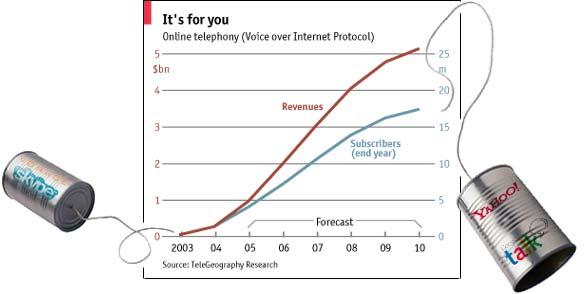
Read this article on how VOIP is impacting the telecom companies (or could impact). The article focuses on the number of users switching to VOIP and that the traditional companies could see a fall of upto 25 % revenue in the next few years.
I think VOIP could be the disruptive technology often referred to by Clayton M. Christensen in his book 'the innovator's dilemma' . This technology although just below the required performance levels of the regular telecom market is fast improving and moving into the rapid adoption phase. Now with microsoft, skype and google behind it , it should not be long before more rapid adoption happens.
all of the above should be great for the consumer, but what will happen to the telecom industry ...i would guess that their entire business model could get disrupted in the next few years ...what does this mean for companies like VSNL, bharti or reliance infocomm ?
some of them could face pain but would evolve with the new technology like reliance or bharti ..but i would not be too optimisitic for VSNL, MTNL and some others
i would be wary of investing in the telecom sector for a long term basis
How VOIP would impact the Telecom industry
Read this article on how VOIP is impacting the telecom companies (or could impact). The article focuses on the number of users switching to VOIP and that the traditional companies could see a fall of upto 25 % revenue in the next few years.
I think VOIP could be the disruptive technology often referred to by Clayton M. Christensen in his book 'the innovator's dilemma' . This technology although just below the required performance levels of the regular telecom market is fast improving and moving into the rapid adoption phase. Now with microsoft, skype and google behind it , it should not be long before more rapid adoption happens.
all of the above should be great for the consumer, but what will happen to the telecom industry ...i would guess that their entire business model could get disrupted in the next few years ...what does this mean for companies like VSNL, bharti or reliance infocomm ?
some of them could face pain but would evolve with the new technology like reliance or bharti ..but i would not be too optimisitic for VSNL, MTNL and some others
i would be wary of investing in the telecom sector for a long term basis
Tuesday, September 06, 2005
Kothari products ltd - A Net cash graham situation
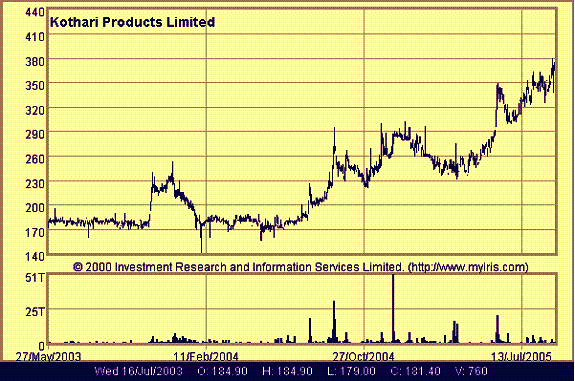
I was running my screen in the year 2003 and came across kothari products. This was a company with 240 crs cash and equivalent (net of debt) on the balance sheet with a market cap of 80 crs ( i think they had 40 mn outstanding shares @ 170 rs / share). They currently have almost 300 crs (around 600 rs per share )
They were fairly profitable (although the profits were down). The market had beaten down the price due to legislation issues (The maharashtra government had banned Pan masala / gutka - their main products). The company was still profitable, although the profits had come down due to drop in sales. Its free cash flow is same as its net profit because Gutka and other tobacco products require little capex for plant and machinery or working capital. The main asset is the brand (in this case pan parag ). So their profits were pure cash for the owners
I bought the share at an price of Rs 160 – 170 a share and sold around 260 per share. The reason I sold was lack of information from the company ( their website is poorly updated in terms of financial results). In addition, I was not sure what the promoters were planning to do with the cash ( the promoters hold almost 70 % of the company).
So what’s the point of the whole thing …Its not that it was a profitable investment. Rather, although I made money on the whole thing, I did not have a very comfortable feeling with the investment. If I compare it with the other purchases I have done such as asian paints, or a concor which are good businesses with good management, this one made me uncomfortable as there was no transparency from the company. In the end I decided to get out rather than face an unpleasant surprise from the management.
My investment philosophy is closer to that of buffet where I end up buying good to great companies at fair prices and get a good night’s sleep. The above was an experiment in a graham style investment. It was profitable and based on a sound approach. But somehow requires more diversification and purchase in not so great enterprises.
Do you have a similar experience? please feel free to share with me
Kothari products ltd - A Net cash graham situation
I was running my screen in the year 2003 and came across kothari products. This was a company with 240 crs cash and equivalent (net of debt) on the balance sheet with a market cap of 80 crs ( i think they had 40 mn outstanding shares @ 170 rs / share). They currently have almost 300 crs (around 600 rs per share )
They were fairly profitable (although the profits were down). The market had beaten down the price due to legislation issues (The maharashtra government had banned Pan masala / gutka - their main products). The company was still profitable, although the profits had come down due to drop in sales. Its free cash flow is same as its net profit because Gutka and other tobacco products require little capex for plant and machinery or working capital. The main asset is the brand (in this case pan parag ). So their profits were pure cash for the owners
I bought the share at an price of Rs 160 – 170 a share and sold around 260 per share. The reason I sold was lack of information from the company ( their website is poorly updated in terms of financial results). In addition, I was not sure what the promoters were planning to do with the cash ( the promoters hold almost 70 % of the company).
So what’s the point of the whole thing …Its not that it was a profitable investment. Rather, although I made money on the whole thing, I did not have a very comfortable feeling with the investment. If I compare it with the other purchases I have done such as asian paints, or a concor which are good businesses with good management, this one made me uncomfortable as there was no transparency from the company. In the end I decided to get out rather than face an unpleasant surprise from the management.
My investment philosophy is closer to that of buffet where I end up buying good to great companies at fair prices and get a good night’s sleep. The above was an experiment in a graham style investment. It was profitable and based on a sound approach. But somehow requires more diversification and purchase in not so great enterprises.
Do you have a similar experience? please feel free to share with me
Monday, September 05, 2005
A great talk on value investing from Prof. Bakshi
I visit prof. bakshi's blog regularly. He just posted a talk he gave on valueinvesting at the oxford bookstore in 2002. Great presenation with examples which have done well in the last 3 years. One can learn a lot on valueinvesting (and more in an indian context) from him and his posts.
A great talk on value investing from Prof. Bakshi
I visit prof. bakshi's blog regularly. He just posted a talk he gave on valueinvesting at the oxford bookstore in 2002. Great presenation with examples which have done well in the last 3 years. One can learn a lot on valueinvesting (and more in an indian context) from him and his posts.
Watchout investors !!
A new website from SEBI and ministry of company affairs which lists any non complaince or any voilation of guidelines or rules by people associated with any public listed companies. Great step towards transparency and investor eductation !!
watchoutinvestors.com is a national web-based registry covering entities including companies and intermediaries and, wherever available the persons associated with such entities, who have been indicted for an economic default and/or for non-compliance of laws/guidelines and/or who are no longer in the specified activity. This information which is presently disorganized, difficult-to-use and is spread across a large number of sources i.e. websites, databases, publications, notifications and orders of the government and of other organizations, agencies, courts of law, tribunals and commissions, has been aggregated, indexed, standardised ,reformatted and re-presented in a form and manner that can be accessed in a user friendly manner.
watchoutinvestors.com is a national web-based registry covering entities including companies and intermediaries and, wherever available the persons associated with such entities, who have been indicted for an economic default and/or for non-compliance of laws/guidelines and/or who are no longer in the specified activity. This information which is presently disorganized, difficult-to-use and is spread across a large number of sources i.e. websites, databases, publications, notifications and orders of the government and of other organizations, agencies, courts of law, tribunals and commissions, has been aggregated, indexed, standardised ,reformatted and re-presented in a form and manner that can be accessed in a user friendly manner.
Watchout investors !!
A new website from SEBI and ministry of company affairs which lists any non complaince or any voilation of guidelines or rules by people associated with any public listed companies. Great step towards transparency and investor eductation !!
watchoutinvestors.com is a national web-based registry covering entities including companies and intermediaries and, wherever available the persons associated with such entities, who have been indicted for an economic default and/or for non-compliance of laws/guidelines and/or who are no longer in the specified activity. This information which is presently disorganized, difficult-to-use and is spread across a large number of sources i.e. websites, databases, publications, notifications and orders of the government and of other organizations, agencies, courts of law, tribunals and commissions, has been aggregated, indexed, standardised ,reformatted and re-presented in a form and manner that can be accessed in a user friendly manner.
watchoutinvestors.com is a national web-based registry covering entities including companies and intermediaries and, wherever available the persons associated with such entities, who have been indicted for an economic default and/or for non-compliance of laws/guidelines and/or who are no longer in the specified activity. This information which is presently disorganized, difficult-to-use and is spread across a large number of sources i.e. websites, databases, publications, notifications and orders of the government and of other organizations, agencies, courts of law, tribunals and commissions, has been aggregated, indexed, standardised ,reformatted and re-presented in a form and manner that can be accessed in a user friendly manner.
Blogging for dollar - A new business model for individuals ?
Came across this blog from darren. He seems to have made 100000 usd via blogging in the last 1 year. Seems to be an interesting business model. Can this become a full time source of income ? i dont think so ( and darren suggests the same).
But i think blogs can be become a powerful tool for small time entreprenuers and a creative outlet for a lot of people. In addition a lot of companies can use blogs for internal and external communication (with customers ). Microsoft seems to be doing so.
We may see some companies use blogs in addition to their website to get closer to their customer (experience marketing ?)
It would interesting to see how this medium develop. But it would be safe to say a handful will achieve prominence ( the ones which will pass the tipping point ??) , whereas the rest would remain a labor of love (or pain if you are in it for the money only )
there is an interesting post i read on mark cuban's blog on a similar topic - podcasting
But i think blogs can be become a powerful tool for small time entreprenuers and a creative outlet for a lot of people. In addition a lot of companies can use blogs for internal and external communication (with customers ). Microsoft seems to be doing so.
We may see some companies use blogs in addition to their website to get closer to their customer (experience marketing ?)
It would interesting to see how this medium develop. But it would be safe to say a handful will achieve prominence ( the ones which will pass the tipping point ??) , whereas the rest would remain a labor of love (or pain if you are in it for the money only )
there is an interesting post i read on mark cuban's blog on a similar topic - podcasting
Blogging for dollar - A new business model for individuals ?
Came across this blog from darren. He seems to have made 100000 usd via blogging in the last 1 year. Seems to be an interesting business model. Can this become a full time source of income ? i dont think so ( and darren suggests the same).
But i think blogs can be become a powerful tool for small time entreprenuers and a creative outlet for a lot of people. In addition a lot of companies can use blogs for internal and external communication (with customers ). Microsoft seems to be doing so.
We may see some companies use blogs in addition to their website to get closer to their customer (experience marketing ?)
It would interesting to see how this medium develop. But it would be safe to say a handful will achieve prominence ( the ones which will pass the tipping point ??) , whereas the rest would remain a labor of love (or pain if you are in it for the money only )
there is an interesting post i read on mark cuban's blog on a similar topic - podcasting
But i think blogs can be become a powerful tool for small time entreprenuers and a creative outlet for a lot of people. In addition a lot of companies can use blogs for internal and external communication (with customers ). Microsoft seems to be doing so.
We may see some companies use blogs in addition to their website to get closer to their customer (experience marketing ?)
It would interesting to see how this medium develop. But it would be safe to say a handful will achieve prominence ( the ones which will pass the tipping point ??) , whereas the rest would remain a labor of love (or pain if you are in it for the money only )
there is an interesting post i read on mark cuban's blog on a similar topic - podcasting
Saturday, September 03, 2005
Good articles on value investing
Mr Sanjay bakshi is a visiting professor at Management Development Institute, Gurgaon, India. He has a blog - http://www.fundoo_professor.blogspot.com/ and a website http://www.sanjbak.com/ .
He is also the CEO of Tactica Capital Management, an investment boutique. There some very good articles on his website which really worth reading
He is also the CEO of Tactica Capital Management, an investment boutique. There some very good articles on his website which really worth reading
Good articles on value investing
Mr Sanjay bakshi is a visiting professor at Management Development Institute, Gurgaon, India. He has a blog - http://www.fundoo_professor.blogspot.com/ and a website http://www.sanjbak.com/ .
He is also the CEO of Tactica Capital Management, an investment boutique. There some very good articles on his website which really worth reading
He is also the CEO of Tactica Capital Management, an investment boutique. There some very good articles on his website which really worth reading
Tuesday, August 23, 2005
Reading a book on Bill miller
I have been reading a book on bill miller from janet lowe
A few things which I learnt
- It is critical to develop a multi-disciplinary model to evaluate companies. This is getting more important as new companies would have more intangible assets than tangible ones and would depend on network effects / customer lock-in etc to create value (like e-bay). even old economy companies will have some component of new economy companies (think about the website of most retailers )
- Importance of understanding business models of these new economy companies and avoiding slotting them into incorrect categories. Bill miller gives an example of amazon.com which is looked at as a retailer and as a result the market has got it wrong several times. According to miller, business model of amazon is closer to dell than walmart (although amazon is using the same wallmart strategy , but online – keep the gross margins constant and pass the benefits to the consumer to build scale )
- The market typically makes an error in evaluating a new business model and is slow to recognize it (but eventually it does). So an investor like miller who has the foresight , can beat the market on these companies (examples given were for dell and amazon )
- Concepts such as network effects, customer lock-in and increasing returns have been discussed briefly in the book with some example.
- Some example of companies which have both new and old economy models
- The book brings out bill miller’s capability to think independently and stand against the crowd ( there is an incident narrated in the book , where it seems in the baron’s panel , one of member asked if bill was drunk when he bought amazon in 2001 – eventually bill was vindicated on his decision
One the most important points which I learnt from the book was to develop an open mind on the new concepts which are coming up and the way they are being used by value investors like bill miller. The growth v/s value tag seems to be immaterial for any company as long as one can assess the intrinsic value of a company and buy it at a discount. Although I may find it difficult to apply these concepts directly, I think these new concepts would help me analyzing and appreciating the new business models which are developing
A few things which I learnt
- It is critical to develop a multi-disciplinary model to evaluate companies. This is getting more important as new companies would have more intangible assets than tangible ones and would depend on network effects / customer lock-in etc to create value (like e-bay). even old economy companies will have some component of new economy companies (think about the website of most retailers )
- Importance of understanding business models of these new economy companies and avoiding slotting them into incorrect categories. Bill miller gives an example of amazon.com which is looked at as a retailer and as a result the market has got it wrong several times. According to miller, business model of amazon is closer to dell than walmart (although amazon is using the same wallmart strategy , but online – keep the gross margins constant and pass the benefits to the consumer to build scale )
- The market typically makes an error in evaluating a new business model and is slow to recognize it (but eventually it does). So an investor like miller who has the foresight , can beat the market on these companies (examples given were for dell and amazon )
- Concepts such as network effects, customer lock-in and increasing returns have been discussed briefly in the book with some example.
- Some example of companies which have both new and old economy models
- The book brings out bill miller’s capability to think independently and stand against the crowd ( there is an incident narrated in the book , where it seems in the baron’s panel , one of member asked if bill was drunk when he bought amazon in 2001 – eventually bill was vindicated on his decision
One the most important points which I learnt from the book was to develop an open mind on the new concepts which are coming up and the way they are being used by value investors like bill miller. The growth v/s value tag seems to be immaterial for any company as long as one can assess the intrinsic value of a company and buy it at a discount. Although I may find it difficult to apply these concepts directly, I think these new concepts would help me analyzing and appreciating the new business models which are developing
Reading a book on Bill miller
I have been reading a book on bill miller from janet lowe
A few things which I learnt
- It is critical to develop a multi-disciplinary model to evaluate companies. This is getting more important as new companies would have more intangible assets than tangible ones and would depend on network effects / customer lock-in etc to create value (like e-bay). even old economy companies will have some component of new economy companies (think about the website of most retailers )
- Importance of understanding business models of these new economy companies and avoiding slotting them into incorrect categories. Bill miller gives an example of amazon.com which is looked at as a retailer and as a result the market has got it wrong several times. According to miller, business model of amazon is closer to dell than walmart (although amazon is using the same wallmart strategy , but online – keep the gross margins constant and pass the benefits to the consumer to build scale )
- The market typically makes an error in evaluating a new business model and is slow to recognize it (but eventually it does). So an investor like miller who has the foresight , can beat the market on these companies (examples given were for dell and amazon )
- Concepts such as network effects, customer lock-in and increasing returns have been discussed briefly in the book with some example.
- Some example of companies which have both new and old economy models
- The book brings out bill miller’s capability to think independently and stand against the crowd ( there is an incident narrated in the book , where it seems in the baron’s panel , one of member asked if bill was drunk when he bought amazon in 2001 – eventually bill was vindicated on his decision
One the most important points which I learnt from the book was to develop an open mind on the new concepts which are coming up and the way they are being used by value investors like bill miller. The growth v/s value tag seems to be immaterial for any company as long as one can assess the intrinsic value of a company and buy it at a discount. Although I may find it difficult to apply these concepts directly, I think these new concepts would help me analyzing and appreciating the new business models which are developing
A few things which I learnt
- It is critical to develop a multi-disciplinary model to evaluate companies. This is getting more important as new companies would have more intangible assets than tangible ones and would depend on network effects / customer lock-in etc to create value (like e-bay). even old economy companies will have some component of new economy companies (think about the website of most retailers )
- Importance of understanding business models of these new economy companies and avoiding slotting them into incorrect categories. Bill miller gives an example of amazon.com which is looked at as a retailer and as a result the market has got it wrong several times. According to miller, business model of amazon is closer to dell than walmart (although amazon is using the same wallmart strategy , but online – keep the gross margins constant and pass the benefits to the consumer to build scale )
- The market typically makes an error in evaluating a new business model and is slow to recognize it (but eventually it does). So an investor like miller who has the foresight , can beat the market on these companies (examples given were for dell and amazon )
- Concepts such as network effects, customer lock-in and increasing returns have been discussed briefly in the book with some example.
- Some example of companies which have both new and old economy models
- The book brings out bill miller’s capability to think independently and stand against the crowd ( there is an incident narrated in the book , where it seems in the baron’s panel , one of member asked if bill was drunk when he bought amazon in 2001 – eventually bill was vindicated on his decision
One the most important points which I learnt from the book was to develop an open mind on the new concepts which are coming up and the way they are being used by value investors like bill miller. The growth v/s value tag seems to be immaterial for any company as long as one can assess the intrinsic value of a company and buy it at a discount. Although I may find it difficult to apply these concepts directly, I think these new concepts would help me analyzing and appreciating the new business models which are developing
If the market is falling ..why am i smiling ?
for the same reason, when the price of a computer, telecom charges, or any other stuff which i need to buy falls !!
It allows me to buy more of it ....
The above way of thinking is ofcourse not original ...kind of learnt it from warren buffett. But having internalised it, it makes a lot of sense
so every day when the market falls , i smile and hope that the stocks which i am wanting to buy and have not been able to, would be available soon at a good price
It allows me to buy more of it ....
The above way of thinking is ofcourse not original ...kind of learnt it from warren buffett. But having internalised it, it makes a lot of sense
so every day when the market falls , i smile and hope that the stocks which i am wanting to buy and have not been able to, would be available soon at a good price
If the market is falling ..why am i smiling ?
for the same reason, when the price of a computer, telecom charges, or any other stuff which i need to buy falls !!
It allows me to buy more of it ....
The above way of thinking is ofcourse not original ...kind of learnt it from warren buffett. But having internalised it, it makes a lot of sense
so every day when the market falls , i smile and hope that the stocks which i am wanting to buy and have not been able to, would be available soon at a good price
It allows me to buy more of it ....
The above way of thinking is ofcourse not original ...kind of learnt it from warren buffett. But having internalised it, it makes a lot of sense
so every day when the market falls , i smile and hope that the stocks which i am wanting to buy and have not been able to, would be available soon at a good price
Wednesday, August 17, 2005
Is it worth investing in the Oil sector

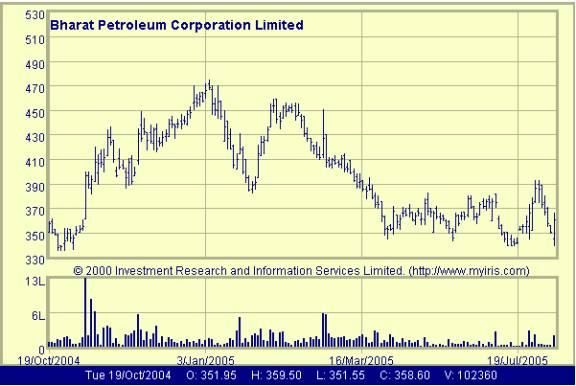
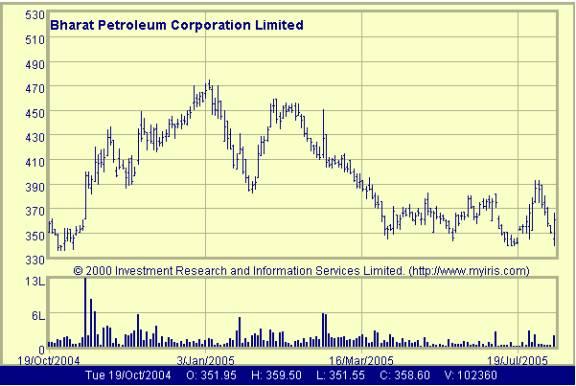
The goverment by controlling the prices is driving the sector to bankruptcy. Trying all kinds of permutations to keep the companies from going bankrupt (see article below). If the oil companies cannot charge market rate (shareholders subsidizing the customer ???!!) , then how is the sector going to make money.
I am still not able to get it (maybe i am missing something ). If the government ( the majority shareholder ) controls the pricing (and profit) of the oil companies at the expense of the minority shareholder with no concern other than the political impact, what is the value of these companies ? how does one value such companies where the future cash flow in addition to being dependent on a volatile oil market is also dependent on a whimsical majority shareholder which has a non economic agenda ! . This sector would start looking like indian railways if the oil prices remain high (which looks likely), that is chronically sick
typically oil companies make good profits through forward contracts, hedging etc during rising oil prices (more so if they are vertically integrated). But the indian oil companies are actually down when the overall market is up ( see chart )
To provide cushion for under-recoveries — Standalone refineries may be merged with oil marketing cos --- From hindu business line
Our Bureau
New Delhi , Aug. 17
THE Ministry of Petroleum & Natural Gas is weighing the option of merging pure refining companies with oil marketing companies (OMCs) to enable the latter to cushion the impact of high global crude oil prices on their bottomline.
Due to the freeze by the Government on raising retail prices despite the rise in raw material cost, the fuel retailing business is seen as becoming economically unviable, resulting in OMCs such as Indian Oil Corporation, Bharat Petroleum Corporation, Hindustan Petroleum Corporation and IBP suffering losses.
However, standalone refiners in Chennai, Kochi and Mangalore are making profits as they get the international price for the fuel they produce.
Asked whether the Petroleum Ministry was contemplating such a move, the Petroleum Secretary, Mr S.C. Tripathi, told Business Line that, "various options are being considered. In view of the high crude oil price scenario, some serious structural changes could be made in the downstream sector."
About the suggestion made by the Committee on Synergy in Energy to oil companies asking them to consolidate their businesses, the Secretary said, "we are keeping that also in view."
Explaining the rationale behind such a consideration, a Petroleum Ministry official said standalone refiners were currently earning huge margins, while the OMCs were taking a hit. The merger could help in sharing refining margins with OMCs. "But this is a long-term view and may take some time," he said.
Meanwhile, the bleeding OMCs have been seeking a revision in the prices of the four petroleum products - kerosene, LPG, petrol and diesel.
The companies have incurred a cash loss of Rs 1,516 crore in July. They have sought Rs 5.29 per litre increase in petrol and Rs 4.54 a litre hike in diesel prices. Indications are that the Government is unlikely to consider the price revision before the end of the current session of Parliament.
Also, negotiations were on with the Finance Ministry to consider an excise duty cut, senior officials said.
The Government may consider a hike between Rs 1 and 2 per litre each combined with excise duty reduction on petrol from 8 per cent plus Rs 13 a litre to 8 per cent plus Rs 12 a litre and that on diesel from 8 per cent plus Rs 3.25 a litre to 8 per cent plus Rs 2.25 per litre.
Is it worth investing in the Oil sector
The goverment by controlling the prices is driving the sector to bankruptcy. Trying all kinds of permutations to keep the companies from going bankrupt (see article below). If the oil companies cannot charge market rate (shareholders subsidizing the customer ???!!) , then how is the sector going to make money.
I am still not able to get it (maybe i am missing something ). If the government ( the majority shareholder ) controls the pricing (and profit) of the oil companies at the expense of the minority shareholder with no concern other than the political impact, what is the value of these companies ? how does one value such companies where the future cash flow in addition to being dependent on a volatile oil market is also dependent on a whimsical majority shareholder which has a non economic agenda ! . This sector would start looking like indian railways if the oil prices remain high (which looks likely), that is chronically sick
typically oil companies make good profits through forward contracts, hedging etc during rising oil prices (more so if they are vertically integrated). But the indian oil companies are actually down when the overall market is up ( see chart )
To provide cushion for under-recoveries — Standalone refineries may be merged with oil marketing cos --- From hindu business line
Our Bureau
New Delhi , Aug. 17
THE Ministry of Petroleum & Natural Gas is weighing the option of merging pure refining companies with oil marketing companies (OMCs) to enable the latter to cushion the impact of high global crude oil prices on their bottomline.
Due to the freeze by the Government on raising retail prices despite the rise in raw material cost, the fuel retailing business is seen as becoming economically unviable, resulting in OMCs such as Indian Oil Corporation, Bharat Petroleum Corporation, Hindustan Petroleum Corporation and IBP suffering losses.
However, standalone refiners in Chennai, Kochi and Mangalore are making profits as they get the international price for the fuel they produce.
Asked whether the Petroleum Ministry was contemplating such a move, the Petroleum Secretary, Mr S.C. Tripathi, told Business Line that, "various options are being considered. In view of the high crude oil price scenario, some serious structural changes could be made in the downstream sector."
About the suggestion made by the Committee on Synergy in Energy to oil companies asking them to consolidate their businesses, the Secretary said, "we are keeping that also in view."
Explaining the rationale behind such a consideration, a Petroleum Ministry official said standalone refiners were currently earning huge margins, while the OMCs were taking a hit. The merger could help in sharing refining margins with OMCs. "But this is a long-term view and may take some time," he said.
Meanwhile, the bleeding OMCs have been seeking a revision in the prices of the four petroleum products - kerosene, LPG, petrol and diesel.
The companies have incurred a cash loss of Rs 1,516 crore in July. They have sought Rs 5.29 per litre increase in petrol and Rs 4.54 a litre hike in diesel prices. Indications are that the Government is unlikely to consider the price revision before the end of the current session of Parliament.
Also, negotiations were on with the Finance Ministry to consider an excise duty cut, senior officials said.
The Government may consider a hike between Rs 1 and 2 per litre each combined with excise duty reduction on petrol from 8 per cent plus Rs 13 a litre to 8 per cent plus Rs 12 a litre and that on diesel from 8 per cent plus Rs 3.25 a litre to 8 per cent plus Rs 2.25 per litre.
Tuesday, August 16, 2005
Hotel stocks - some number
Pulled out these number from the equityresearchindia website. Pretty depressing economics ....guess one can make money on one can catch the inflexion point when the economy is turning and the hotel industry is poised to do well ...
2005 2004 2003 2002 2001 2000 1999
A) Return on Equity (i x ii) 9.20% 4.40% 3.20% 4.40% 8.90% 9.50% 11.90%
i) Return on Total Assets
4.70% 2.10% 1.60% 2.40% 5.20% 5.90% 7.90%
ii) Total Assets To Total Equity
2 2.1 2 1.8 1.7 1.6 1.5
B) Return on Total Assets (iii x iv) 4.70% 2.10% 1.60% 2.40% 5.20% 5.90% 7.90%
iii) Net Profit Margin
11.10% 6.60% 5.60% 8.20% 13.90% 15.40% 17.20%
iv) Total Assets Turnover
0.4 0.3 0.3 0.3 0.4 0.4 0.5
C) Total Assets Turnover (v / vi) 0.4 0.3 0.3 0.3 0.4 0.4 0.5
v) Total Income (Rs. Cr.)
3103 2452 2052 1924 2241 2012 2078
vi) Average Total Assets (Rs. Cr.)
7374 7597 7023 6577 5959 5260 4495
Hotel stocks - some number
Pulled out these number from the equityresearchindia website. Pretty depressing economics ....guess one can make money on one can catch the inflexion point when the economy is turning and the hotel industry is poised to do well ...
2005 2004 2003 2002 2001 2000 1999
A) Return on Equity (i x ii) 9.20% 4.40% 3.20% 4.40% 8.90% 9.50% 11.90%
i) Return on Total Assets
4.70% 2.10% 1.60% 2.40% 5.20% 5.90% 7.90%
ii) Total Assets To Total Equity
2 2.1 2 1.8 1.7 1.6 1.5
B) Return on Total Assets (iii x iv) 4.70% 2.10% 1.60% 2.40% 5.20% 5.90% 7.90%
iii) Net Profit Margin
11.10% 6.60% 5.60% 8.20% 13.90% 15.40% 17.20%
iv) Total Assets Turnover
0.4 0.3 0.3 0.3 0.4 0.4 0.5
C) Total Assets Turnover (v / vi) 0.4 0.3 0.3 0.3 0.4 0.4 0.5
v) Total Income (Rs. Cr.)
3103 2452 2052 1924 2241 2012 2078
vi) Average Total Assets (Rs. Cr.)
7374 7597 7023 6577 5959 5260 4495
Hotel stocks
Was looking at the latest results of the hotel industry. The headlines are screaming about the triple digit growths and the tight demand supply situation. The rise in tourist inflows / good business climate are being cited as the reason for the optimism.
I am not too excited by the results or by the economics of the hotel industry. It is typical commodity industry. Some companies have good brand names, but do they have a strong franchise. What i mean by that is, can these companies charge a premium price? . Taj and others can charge a premium compared to the other hotels, but when there is excess supply, the typical occupancy rates and ARR (average room rents) suffer. During such period the margins drop and due to the high fixed costs , even the best of the companies can barely remain in black.
So over a complete business cycle most of the companies in this sector can barely cover their cost of capital. The asset turnover ratios are very low and so to earn a return over their cost of capital, most of these hotels need to maintain a Net profit margin in excess of 10 % ( a tall task when times are bad).
On the contrary this industry looks almost like the steel, cement and the other commodity industry, where only a low cost producer like gujarat ambuja or Tata steel can be profitable over the long term. Can't think of any such hotel company ...
Compare this with the FMCG/Pharma/IT and most of these companies even during a downturn, earn over their cost of capital.
As a side note, ITC seems to be investing their cash flows from ciggarette business to hotels, Paper and FMCG which are businesses with poor economics. Granted , that the company is getting growth, but is it profitable ( doesnt seem to be as of now)?
Hotel stocks
Was looking at the latest results of the hotel industry. The headlines are screaming about the triple digit growths and the tight demand supply situation. The rise in tourist inflows / good business climate are being cited as the reason for the optimism.
I am not too excited by the results or by the economics of the hotel industry. It is typical commodity industry. Some companies have good brand names, but do they have a strong franchise. What i mean by that is, can these companies charge a premium price? . Taj and others can charge a premium compared to the other hotels, but when there is excess supply, the typical occupancy rates and ARR (average room rents) suffer. During such period the margins drop and due to the high fixed costs , even the best of the companies can barely remain in black.
So over a complete business cycle most of the companies in this sector can barely cover their cost of capital. The asset turnover ratios are very low and so to earn a return over their cost of capital, most of these hotels need to maintain a Net profit margin in excess of 10 % ( a tall task when times are bad).
On the contrary this industry looks almost like the steel, cement and the other commodity industry, where only a low cost producer like gujarat ambuja or Tata steel can be profitable over the long term. Can't think of any such hotel company ...
Compare this with the FMCG/Pharma/IT and most of these companies even during a downturn, earn over their cost of capital.
As a side note, ITC seems to be investing their cash flows from ciggarette business to hotels, Paper and FMCG which are businesses with poor economics. Granted , that the company is getting growth, but is it profitable ( doesnt seem to be as of now)?
Subscribe to:
Posts (Atom)